
Which Latin American cities have the cleanest air?
Despite challenges in big cities, Latin America is making progress in the fight against air pollution.

Breathe in. Breathe out. How much pollution did you just inhale?
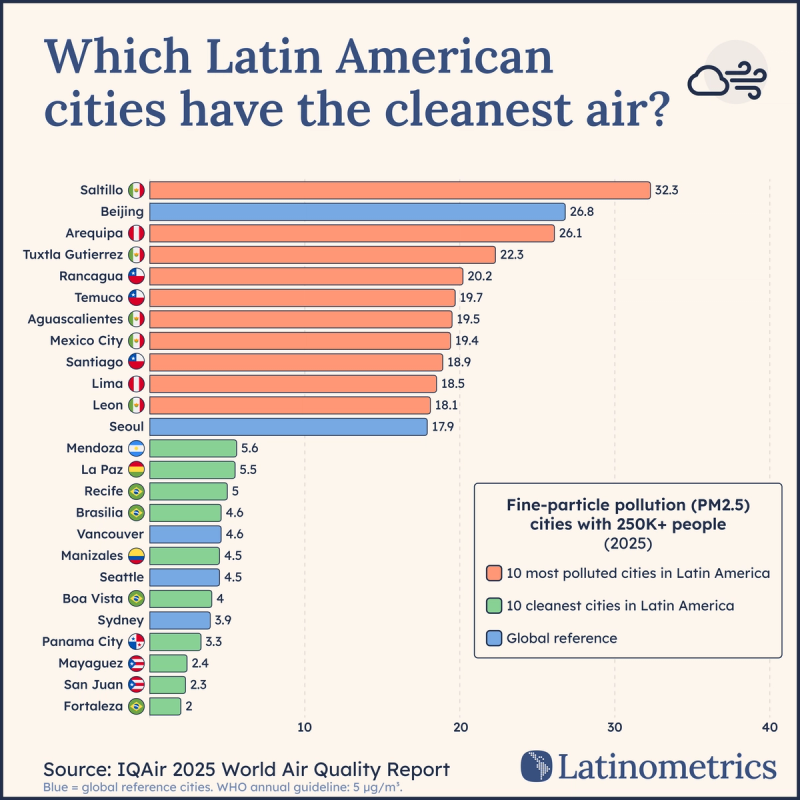
The answer depends largely on where you are. In cities like Lima or Mexico City, the annual average concentration of fine particulate matter (PM2.5) runs nearly 4x the World Health Organization’s guideline of five micrograms per cubic meter (μg/m³).
By contrast, other capitals like Brasília and Panama City sit comfortably below that threshold, a reminder of just how unevenly the region breathes.
Air Quality Across Latin America
Although PM2.5 is only one of the six main pollutants monitored by health and environmental agencies worldwide, IQAir’s World Air Quality Report focuses exclusively on this variable to compare air quality across cities and countries across the globe.
Reported in μg/m³, PM2.5 is the scientific term for fine inhalable particles with a diameter of 2.5 micrometers or smaller. For scale, an average human hair is around 70 micrometers wide. So your cough may come from air particles that are 30x tinier than the width of your hair.
At the most polluted end of the scale in Latin America, Mexico and Chile dominated the ranking in 2025 when evaluating mid-sized and large cities with populations of at least 250K inhabitants.
Five of the ten cities with the highest PM2.5 concentrations in the region were in Mexico, while three were in Chile. For comparison, all ten recorded worse yearly air than Seoul, and Saltillo even out-polluted Beijing, a city that spent the past decade (and billions of dollars) clawing its way out of its infamous smog.
Cleaning Up the Air We Breathe
Air quality can nonetheless vary immensely over time depending on pollution sources and the environmental policies implemented by governments. Particulate matter tends to originate from both man-made and natural sources including vehicle combustion, industrial processes, power generation, as well as wildfires and sandstorms.
Chile’s Net-Zero Nature-Positive Accelerator Program, developed in 2025 in partnership with the United Nations, targets multiple sources of air pollution. The initiative aims to cut emissions by decarbonizing energy demand and expanding sustainable mobility while also restoring forests and wetlands to reduce wildfire risk.
Regionally, IQAir recorded largely positive air quality trends, with nearly two-thirds of its dataset’s 325 Latin American cities showing decreases in annual average PM2.5 concentrations.
Progress in Panama and Puerto Rico
In fact, six of the thirteen countries and territories worldwide that met the WHO’s annual guideline of 5 μg/m³ in 2025 were in Latin America and the Caribbean: Barbados, Bermuda, Grenada, Panama, Puerto Rico, and the U.S. Virgin Islands.
With 12% of Latin American cities similarly meeting the WHO annual guideline, six cities recorded better air quality than Vancouver while four even outperformed Sydney. Even Peru, which ranked as the most polluted country in the region when taking into account air quality in smaller cities, placed 40th in a global ranking of countries.
In this heavily urbanized region of the world, these improvements offer reason for optimism. As Latin America’s cities continue to grow, the hope is that more countries can build on the examples of Uruguay and Puerto Rico, which have significantly reduced the share of their populations exposed to air pollution over the past decade and a half.
Source: IQAir 2025 World Air Quality Report
Air quality in Latin American cities vs global reference cities, 2025
Source: IQAir 2025 World Air Quality Report


