
Civic freedoms are slipping across Latin America
Governments across the ideological spectrum increasingly treat protests and journalism as security threats.

In February, thousands took to the streets of Buenos Aires to protest against labor reforms that sought to restrict workers’ right to strike and reduce employment protections.
While the union-organized protest initially unfolded peacefully, security forces used water cannons, rubber bullets, and tear gas after clashes with police. More than 40 people were arrested and within two days the government filed terrorism charges against seventeen people accused of attacking officers and the National Congress.
The following week, the security ministry announced that journalists planning to cover subsequent demonstrations would have to remain within a so-called “exclusive zone,” which press organizations warned would restrict journalists’ ability to observe police conduct and report accurately.
This type of forceful state response has become ever more common across Latin America. April saw at least ten journalists and press workers allegedly assaulted by national police officers while covering a demonstration for higher wages and pensions in Caracas. More recently, between May and June, weeks of protests and nationwide road blockades in Bolivia were met with police and military operations that resulted in over 500 arrests and multiple allegations of excessive force.
The Shrinking Civic Space in Latin America
Across the Americas, many governments are increasingly treating protests, journalism, and civic organizations as security threats rather than democratic safeguards.
The CIVICUS Monitor frames these developments as signs of a closing civic space, meaning the shrinking ability of civil-society actors to exercise freedom of assembly, association, and expression. The Monitor employs local reporting, regional research teams, and internal experts to assess the state of civic spaces worldwide.
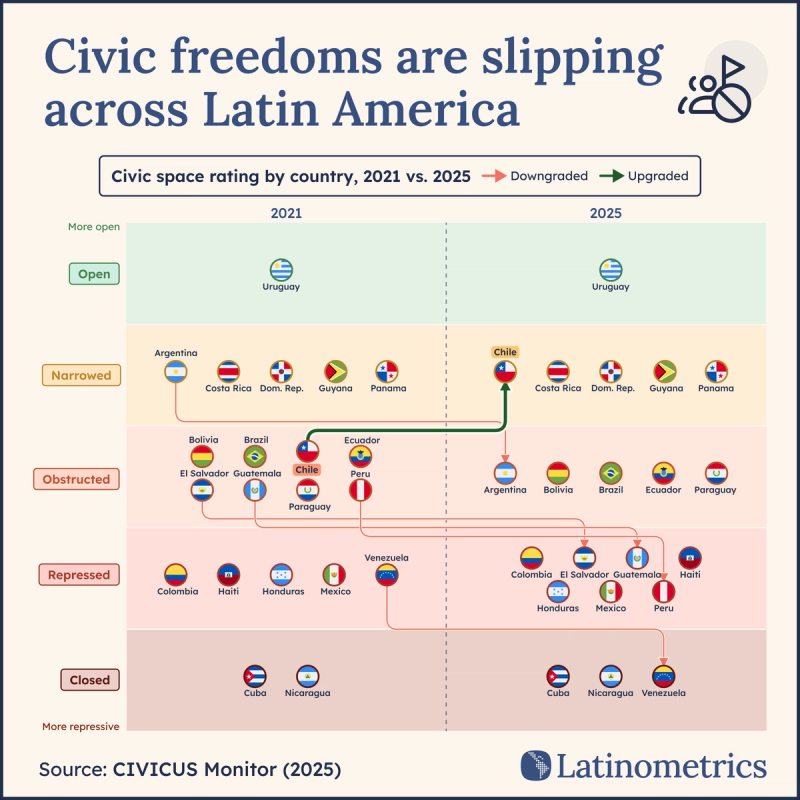
Between 2021 and 2025, the Monitor downgraded five Latin American countries in its ratings: Argentina, El Salvador, Guatemala, Peru, and Venezuela. In March, the organization also placed Ecuador on its watchlist, which features countries experiencing a rapid decline in civic freedoms.
On the flip side, Uruguay is the only country rated as having an open civic space, while Chile is the sole country to have had its civic-space rating upgraded in recent years. More on that second country later.
Why Civic Space Matters
Governments may be left, right, or center, but they tend to restrict civil liberties the same way. One Amnesty International overview, for example, notes growing unlawful surveillance, censorship, and judicial harassment of journalists as recurring patterns in the Americas.
Politicians will often use these measures to reduce the political costs imposed by public opposition. If a government announces an unpopular tax hike or labor reform, and people protest in the streets, the government may choose to crack down on the protests in order to avoid losing control of the narrative or be seen as politically weak.
Governments will often complement these control efforts with changes in the legal repercussions of protesting, or constraints in journalists’ freedom to cover protests. In the process, they can pursue controversial policies while minimizing political backlash.
Naturally, two things help make this censorship easier. The first is if the courts or relevant regulatory bodies are already either weakened or packed with pro-government loyalists. The second is if polarization is strong enough that opposition figures have been successfully portrayed as enemies to democracy itself.
The Role of the Civic Sphere in Democracy
Targeting the civic space is all the more useful to those politicians seeking to consolidate authoritarian regimes like those currently seen in Cuba, Nicaragua, and Venezuela, the three countries currently classified as having closed civic spaces.
The elimination of political competition and weakening of the public sphere are well-known central features of democratic erosion. By restricting civic space without abolishing elections or formally banning dissent, governments insidiously undermine civic freedoms without evoking the same public concern of democratic breakdown.
After all, if elections allow citizens to replace governments periodically, civic space allows them to hold governments accountable between elections. That function has become ever more important as democratic legitimacy deteriorates across Latin America.
Lessons From Chile
The cycle of growing public discontent and escalating government repression is not inescapable, however.
While civil mobilization remains crucial to defending civic space, breaking the cycle of repression usually involves also a degree of political alignment. In other words, civil society needs political allies that heed to their demands and restrain coercive power.
CIVICUS actually downgraded Chile in 2020 to the “Obstructed” category. The country was reupgraded in 2022; the recently-concluded Gabriel Boric presidency was lauded for implementing reparations for past abuses during mass protests in 2019-2020 as well as for establishing a framework to protect human-rights defenders and journalists going forward.
Chile shows that declining civic space is indeed neither inevitable nor irreversible. While this progress is likely to be tested under new President José Antonio Kast, the country still provides an important lesson about the role of political leadership in upholding public participation as a democratic pillar.
Source: CIVICUS Monitor (2025).


