
Which pensions own, and which just lend?
Mexico's AFOREs lend most of workers' $440B to the government. See how pension funds in 40 countries split stocks, bonds, and cash in 2024.


July 28, 2026 • Reading time: 4 minutes
There's no more meaningful integration in supply chains than the US and Mexico's. As you know by now if you read Latinometrics, it represents the largest trade relationship between any two countries, which only truly boomed since the passing of their trade agreements, beginning in 1992.
Fast forward 34 years, and Mexico now ships $3B worth of products to the US every day on average. The good news is that the supply chain consists of highly specialized products like cars, medical devices, and electronics rather than the more typical export variety in Latin America (commodities like oil, bananas, and more oil). Mexico's economy is differentiated and powered by millions of highly specialized jobs.
A key aspect of the economy, however, leaves a whole lot of integration to be desired: our financial sector. It hasn't lived up to the potential that an economy the size of South Korea commands. Ask where Mexico's most sophisticated investors put their money, and the honest answer is that it's in New York City, not Mexico City, mostly in financial instruments the average Mexican is gated out of.
The market that stayed small
Take Mexico's public markets. The combined market value of all publicly listed companies is worth just about 22% of GDP ($560B). Compare that to Thailand's 99%. Or don't even go too far. Chile's sits at nearly 80%. What does that mean, in practical terms? Just to name one, there's no credible ramp for an innovative startup born in Mexico to develop and grow locally to a sustainable competitive level where it can become public and use capital in the ways the true world-leading companies do. In fact, until pipeline operator Esentia Energy broke the drought in November 2025, Mexico's exchange went eight years without a single IPO. None of the country's startup unicorns, from Kavak to Bitso, has ever listed at home. This means little appetite to innovate, and little capital flowing into independent companies beyond the manufacturing facilities Mexico runs on.
OK so, relative to the economy, the market is small. That doesn't mean a Mexican can't invest in it and make a good return, right? The harsh truth is that if you invested 100 pesos 10 years ago, you would've done only marginally better than simply buying government bonds. Someone with access to the S&P 500 would've done almost 2.6x better than you (all adjusted for inflation).
Where workers' savings go
There is one giant pool of Mexican savings that never left, though: retirement money. Since a landmark 1997 reform, every formal worker in Mexico has had an individual retirement account (their money, in their name) managed by an AFORE, a private administrator licensed to invest those savings until the worker retires. Ten of them operate today, and together they manage 8.3 trillion pesos, about $440B. That's nearly a quarter of Mexico's GDP and the largest pool of investable capital in the country.
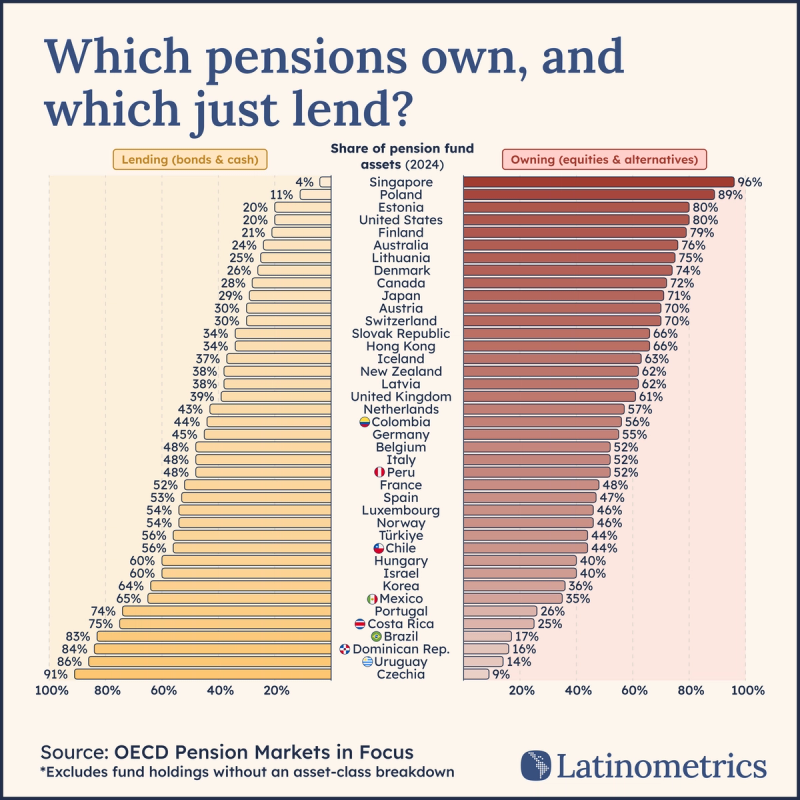
Their investment strategy, however, reveals the gap plainly: in a country like the United States, the overwhelming majority of pension capital is destined to assets that give the owners of that capital actual skin in the game; it incentivizes a whole cycle of prosperity between enterprise and the common mother or father saving for retirement. Mexican AFOREs opt for a much simpler approach: half of everything they manage is lent right back to their own government, making workers' retirement savings one of the largest holders of federal debt. A worker's savings end up funding the government's deficit rather than a stake in the country's growth.
Source: OECD Pension Markets in Focus 2025. Chart shares exclude fund holdings the OECD can't classify by asset type (rightmost column) and rescale the rest to 100%.
Thirty years ago, Mexico decided to integrate its factories with the US, and that bet transformed the economy. Integrating its money would be the natural sequel. So which will it be? Does Mexico build the plumbing to keep its capital and its most sophisticated people at home, or does it keep exporting both to New York?
Pension fund asset allocation by country and asset class, end-2024
Source: OECD Pension Markets in Focus 2025. Chart shares exclude fund holdings the OECD can't classify by asset type (rightmost column) and rescale the rest to 100%.


