
What is Mexico’s trade surplus with the United States?
Mexico just displaced China as the US's top trade partner, fueling a $150B surplus.

What comes to mind when we bring up the 1990s?The end of the Cold War? The Oslo Accords? Your team winning back-to-back championships at the Copa America?
Well, today we’re going to talk about Mexico and the United States (US). So inevitably, we have to turn back the clock a bit and discuss the North American Free Trade Agreement (NAFTA), implemented in 1994, which created the world’s largest free trade bloc when measured by Gross Domestic Product.
Partially as a result of free trade with its northern neighbors, Mexico’s economy has nearly tripled in size since 1994. Meanwhile, its commercial profile has been irrevocably altered—the US and Canada serve as the country’s largest trade partners, in contrast with much of the rest of Latin America.
While the US makes up just about 43% of Mexico’s total imports, it’s in Mexican exports to the north that we see just how much this relationship has deepened over the years. The two economies move in sync today, and when US consumers and businesses want to buy quality foreign goods at a fair price, Mexico is by far the key provider.
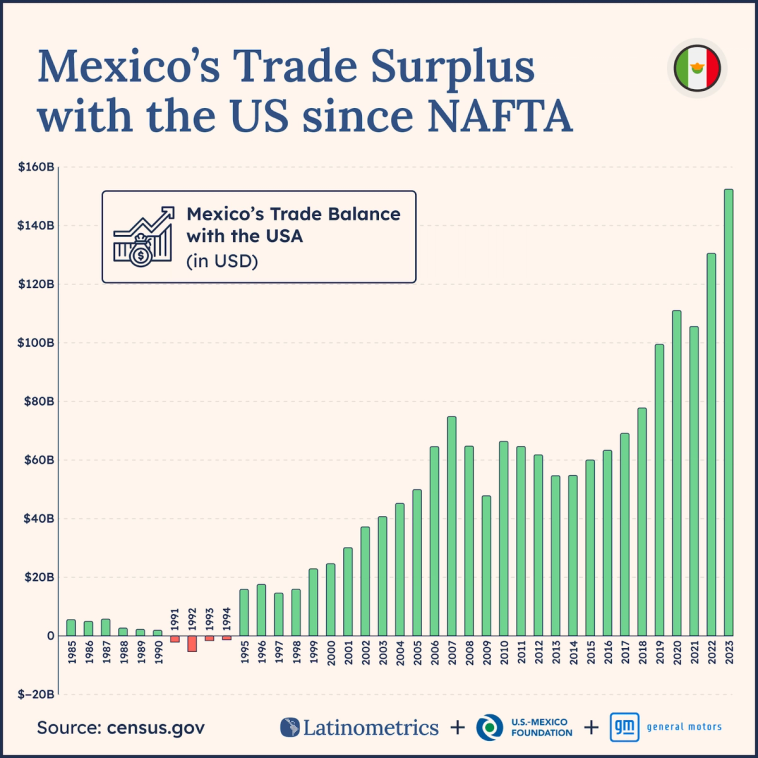
As a result of this, Mexico’s 1994 trade deficit with the US has become a $150B trade surplus last year.
Evidently, Mexican exports are on a roll, as the country’s businesses have capitalized on their comparative advantage and proximity to the world’s largest consumer market. But what exactly are Americans buying en masse from their southern neighbors? As it turns out…a little bit of everything.
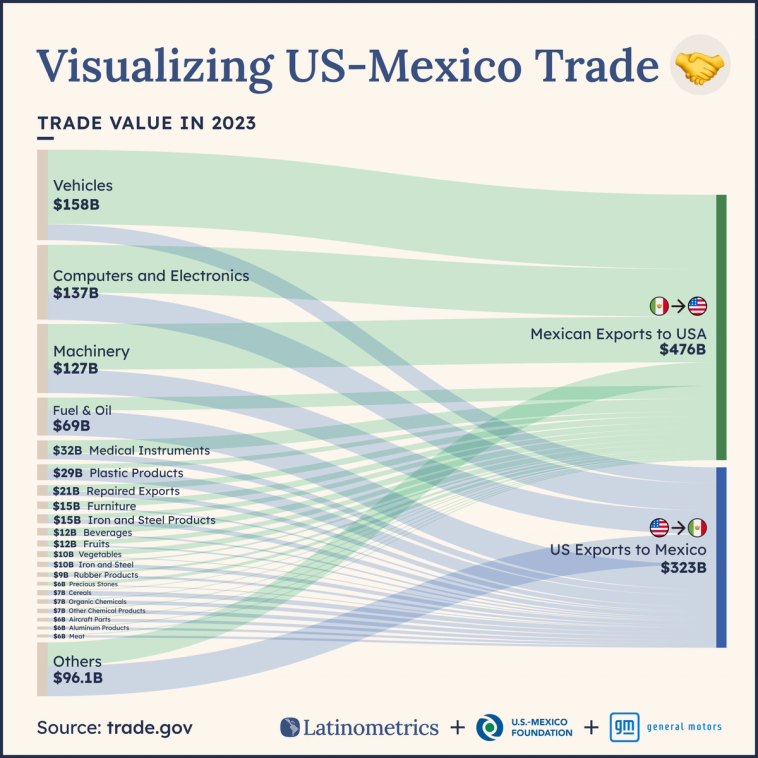
In fact, vehicles make up Mexico’s largest export category, as both regional and international firms use the country’s great trade terms – and ideal geographic location – to set up factories. But more on that later.
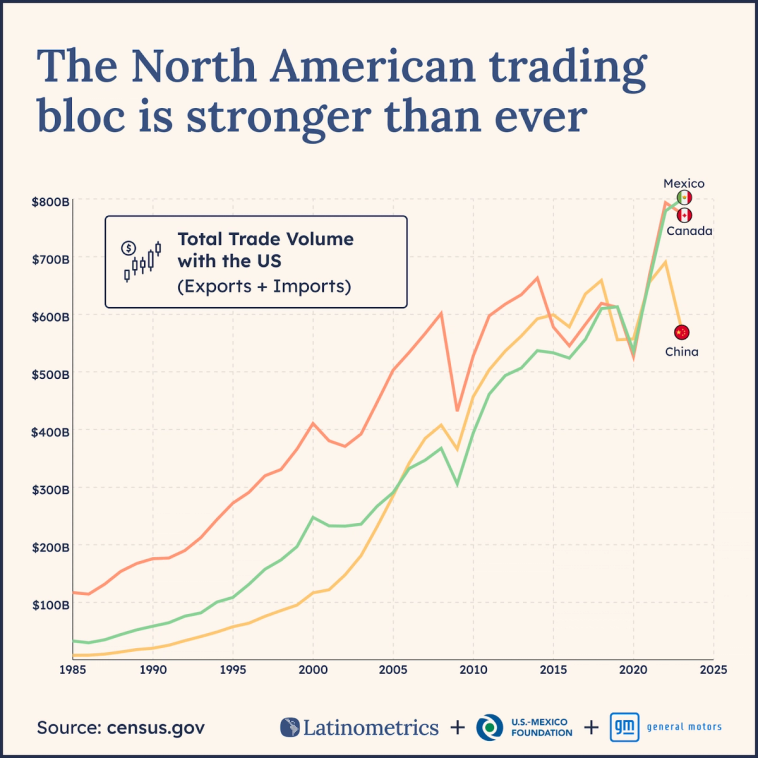
Given this level of export activity, as well as Mexico’s famously hard-working and resourceful labor force, it should be no surprise that just last August the country displaced China as the number-one trading partner for the United States. With Canada maintaining a solid second place, this shift reflects a growing trend in the US away from China and towards more traditional trading partners closer to home.
While by no means this reflects an actual decoupling of the intertwined economies of the US and China, a few things have spelled trouble for the commercial relationship of the world’s two largest superpowers. Trade disputes and increased geopolitical competition between Washington and Beijing have played their part, especially since the imposition of sweeping US tariffs in 2018, as has a general slowdown in China’s economic growth.
Then there are the supply chain disruptions seen throughout the years of the pandemic and afterwards, as crises from Eastern Europe to the Middle East have made investors and business leaders increasingly cautious. And though trade is rarely a zero-sum game, the past few years have demonstrated that Mexico has more to gain than perhaps anybody from this new trend prioritizing nearby trading partners and allies—what’s often called nearshoring or ally-shoring.
Don’t believe us? See for yourselves.
As we touched upon earlier, the automotive industry forms a key part of the great North American regional economy. This has been the case under both NAFTA and the subsequent United States—Mexico—Canada Agreement (USMCA), which was signed in 2018 but essentially modernized the existing agreement. The market for light and medium vehicles in North America was estimated in 2020 to be worth over $700B.
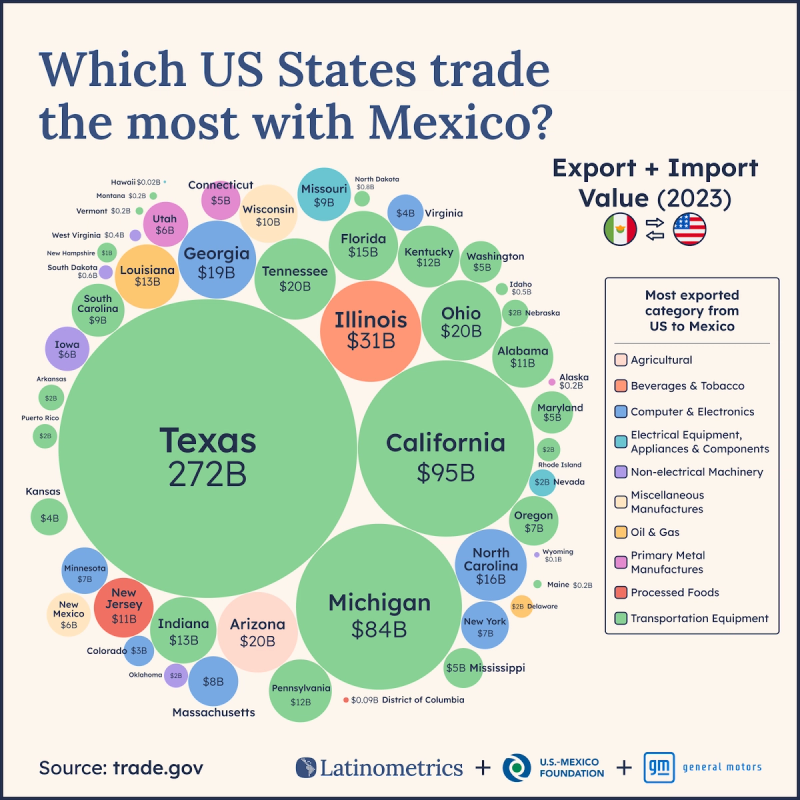
From auto-parts and related goods to finished vehicles, transportation equipment remains the largest two-way trading category between Mexico and many US border states across the Southwest and Midwest. This list includes Texas, California, and (interestingly) Michigan, the former auto capital of the world and a border state on the other side of the country. Part of this continued vehicular dominance is in no small part due to a USMCA provision requiring automakers to source at least 75% of their car parts from North American sources.
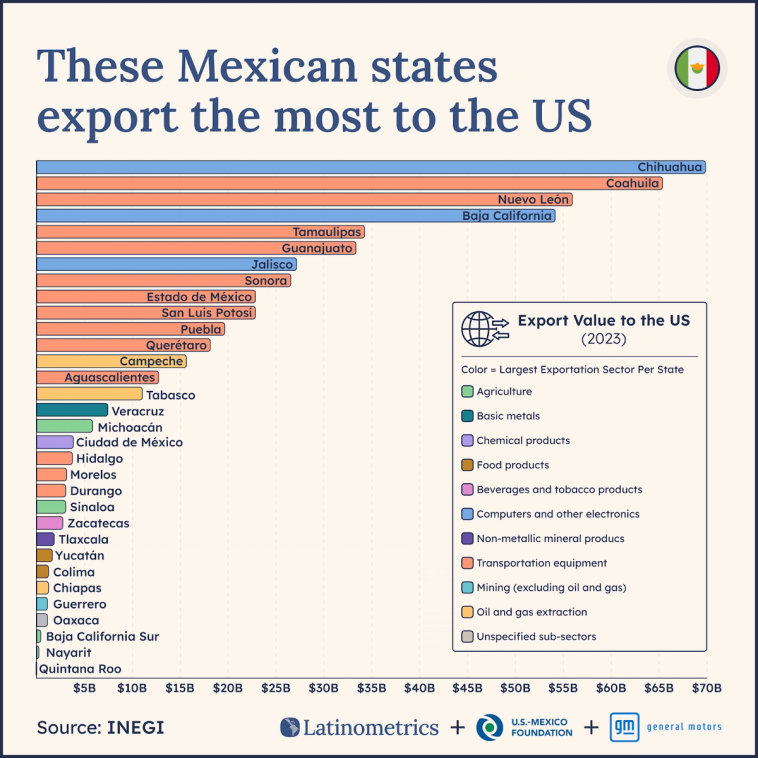
So trade across the Rio Grande is evidently just as important for Mexico’s economy as it is for the US one, if not more. For decades now, the bilateral commercial relationship has been responsible for millions of jobs across central and northern Mexico, especially since the Border Industrialization Program of 1965 and the cropping up of tariff-free factories known as maquiladoras.
In fact, such close integration with the US may well have led to Mexico avoiding the path of many of its counterparts down in South America, which have struggled to industrialize and leave behind agriculture and primary extractive industries as their economic engines.
Today manufacturing plays a significant role in the Mexican economy alongside trade in both high-value goods and services. And this is likely to persist, given that over half of the staggering $36B invested into Mexico last year went to manufacturing—led, of course, by the auto industry.
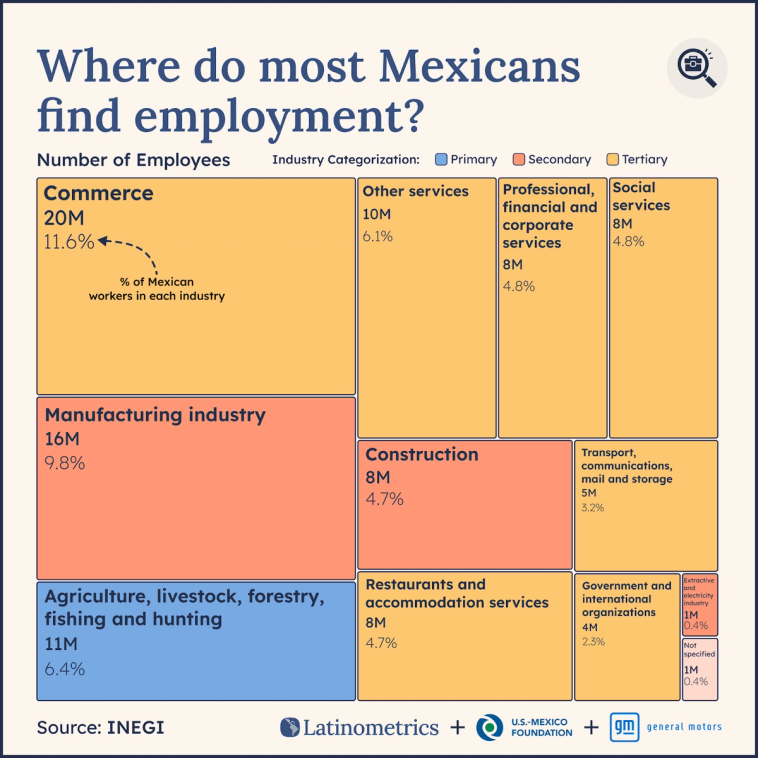
But whether it be due to agricultural, energy, or manufactured exports, it’s undeniable today that the US–Mexico commercial relationship is critical for both countries, despite any political arguments to the contrary.
Last year, two-way trade reached just shy of $800B. For reference, that figure is roughly half the size of Mexico’s total GDP. Decades of policy cooperation, economic push-and-pull, and deepening integration have led to complementary industries in each country, where today the average car part will cross a North American border eight times throughout the manufacturing process.
This level of integration rivals that of even other developed regions such as the European Union. It builds upon each North American country’s comparative advantages and key resources. And from Tijuana to Brownsville, from Mexico City to Washington D.C., the US—Mexico relationship grows the prosperity and success of both countries.


