
The 'Northern Triangle' Receives More Remittances than China
The Northern Triangle's remittances surpass China's, revealing surprising economic ties.

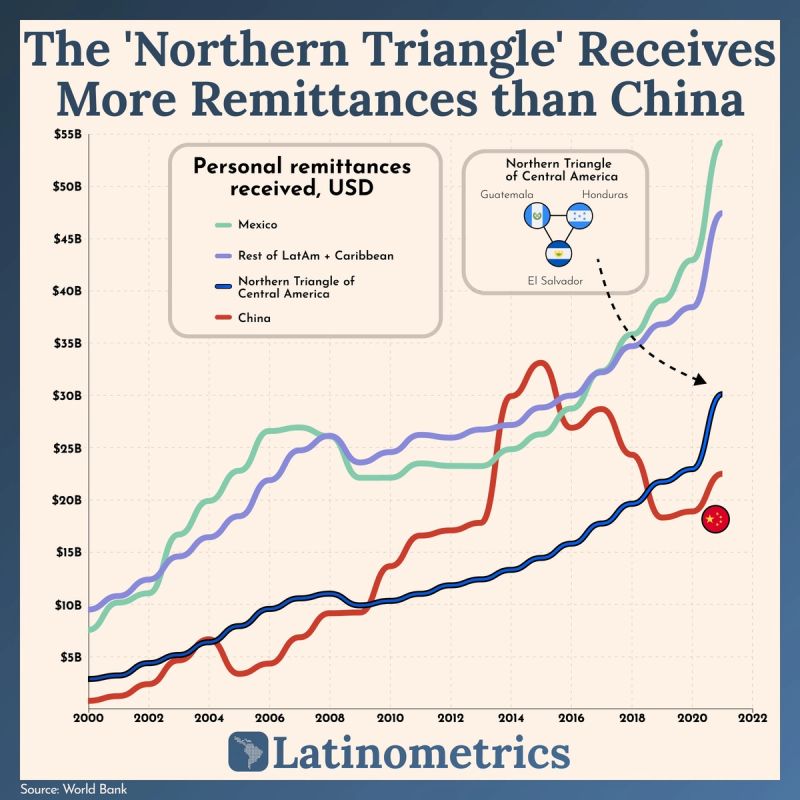
Guatemala, El Salvador, and Honduras were baptized as Central America's "Northern Triangle" in 2000 when they all signed a free trade agreement with Mexico. The US has recently brought the term back into the mainstream. The country is deeply interested in developing local infrastructure and business, and maintaining strong ties.
Why? First, because they're the last of a dying breed of LatAm countries that still trade more with the US than with China. But even more importantly, the US has been facing an immigration crisis coming from Central America. This can only be mitigated in the long run by giving better opportunities to potential immigrants to earn a decent living in their home countries.
On the positive side, remittances show billions of dollars flowing into the Northern Triangle. On the not-so-positive side, each remittance payment tells the story of someone who made the difficult decision to leave their country in search of better opportunities for themselves and their loved ones. Almost all remittances come from the US. And the Northern Triangle has grown highly dependent on them — they make up 21% of the group's combined GDP.
On the other hand, China has been on an economic development rocket ship unlike anything else we've seen in our lifetimes, surpassing LatAm's (+ Caribbean) entire GDP in 2008, the EU's in 2021, and becoming the second-biggest economy. As you can imagine, growing your GDP 15x in 20 years brings about new opportunities for your citizens, which is partly why remittance payments to China stopped increasing — they're not as necessary anymore. They barely represent 1% of GDP.
To give some perspective on how remarkable it is that the Northern Triangle's remittances surpassed China, consider that China's population of 1.4B is equal to 41x the population of the three countries' total population.
Lastly, let's consider — is Mexico (also charted) becoming LatAm's China?
Mexico has shown many positive economic indicators lately — foreign investment is way up, unemployment is way down, and the peso is strong. Could this all point to a new era of growth resembling China's? Despite Mexico accounting for 41% of all LatAm remittances ($54B), the country is relatively non-dependent on them, accounting for only 4% of its GDP. Given this, it makes sense that Mexico is part of MINT — a group of countries (also including Indonesia, Nigeria, and Turkey) expected to be major economic players in the coming decades.
For more on how these flows shape the region, see how remittances keep Central America afloat and our deep dive into where the world's $759B in remittances went.


