
Where is immigration feared most in LatAm?
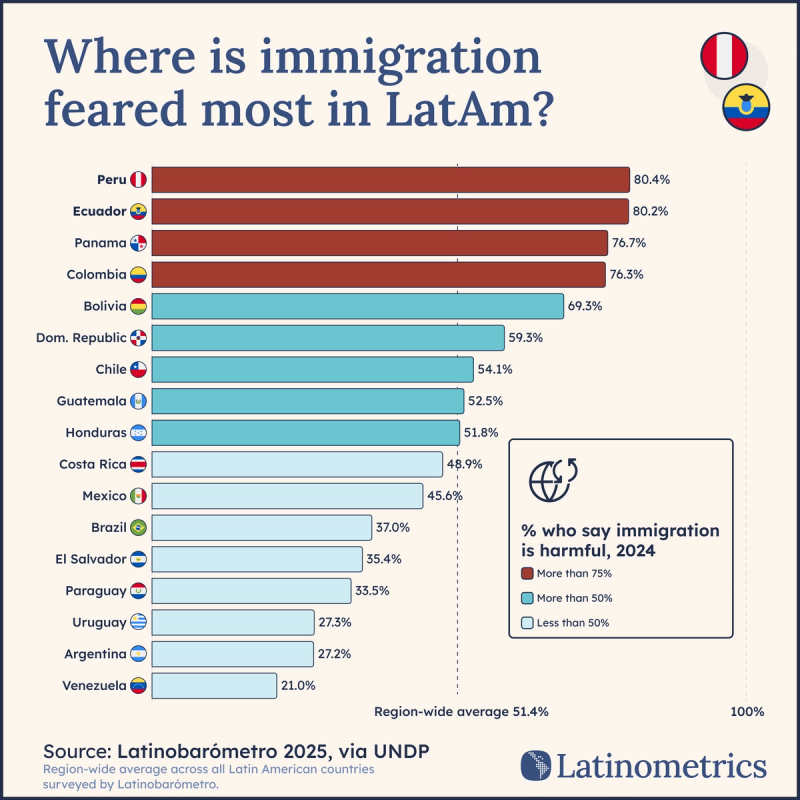
Peru and Ecuador top Latinobarómetro's 2025 ranking on immigration, while Venezuela, the country people are leaving, worries least.

The recent election of Keiko Fujimori to the Peruvian presidency is the most recent sign of her country's shifting views of migration.
As the chart above shows, eight in ten Peruvians now see immigration as harmful. Fujimori's conservative, tough-on-crime rhetoric thus helped her in the presidential race, particularly as her campaign associated immigrants with declining public safety and growing economic resentment.
The shift in perception no doubt partly stems from the greater visibility of migrants, particularly Venezuelans, in the country in recent years.
Peru's New Immigrant Population
Peru was once praised for its humanitarian response to the Venezuelan humanitarian crisis, particularly after 2017. The country became home to the second-largest Venezuelan diaspora population in Latin America, behind only neighboring Colombia. Venezuelans make up over 85% of all immigrants in Peru and are thus highly visible in many Peruvian cities.
Yet the mere presence of Venezuelans is not itself responsible for anti-migrant sentiment. In fact, local exposure to Venezuelan migrants has not been shown to lead to more xenophobia across Latin America.
The backlash in Peru instead grew out of a national narrative that increasingly connected migration to crime, job scarcity, and institutional breakdown. As seen elsewhere in Latin America, Peruvians have been (fairly successfully) convinced that migrants are threats to the local social order.
The Easy Scapegoat
In a country grappling with seemingly chronic political instability, rising organized crime, and a largely informal workforce, the hypervisible Venezuelan migrant has become an easy outlet for public frustration.
This became especially clear as crime levels have soared. High-profile cases involving Venezuelan nationals, coupled with the regional spread of organizations like Tren de Aragua, have helped to convert relatively isolated incidents into a larger narrative of migrant crime.
And this narrative found a welcome audience. After all, more Peruvians have cited crime and public safety as the top issue facing their country than anything else, much like in neighboring Chile and Ecuador.
So Fujimori's victory is not a sign that Peruvians are turning against migrants, but partly a reflection that many already have.
Share who say immigration is harmful to their country, by Latin American nation (2024)
Source: Latinobarómetro (2025), via UNDP. Regional average across the 17 countries surveyed: 51.4%.
Source: Latinobarómetro (2025), via UNDP. Regional average across the 17 countries surveyed: 51.4%.


