
From the presidential palace to a prison cell
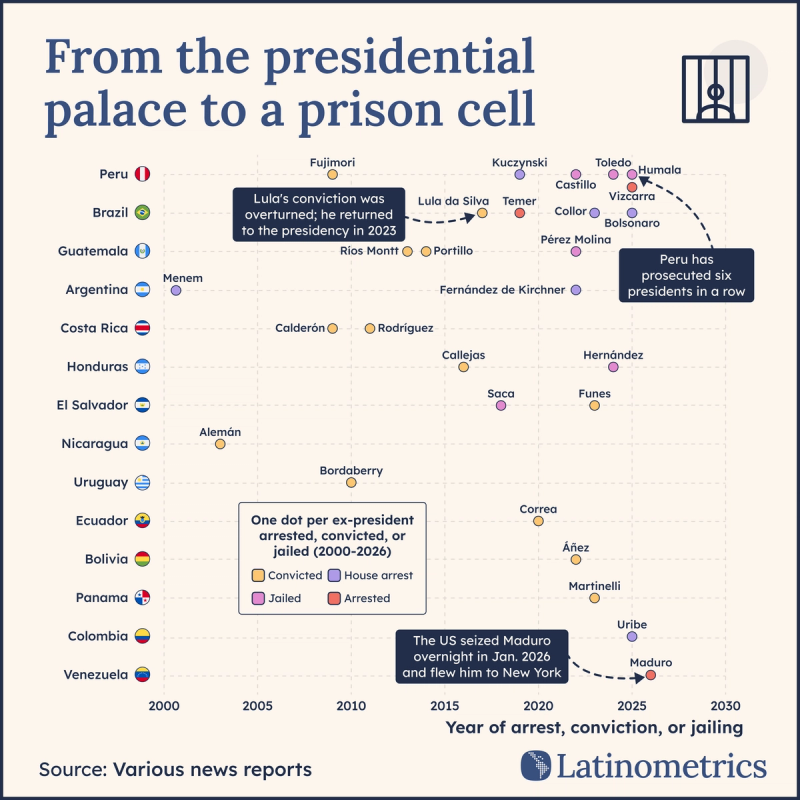
Latin America once removed presidents by coup. Since 2000, at least 28 have faced arrest, conviction, or jail instead.

Government accountability can be a difficult thing.
Across the world, leaders often act with impunity, facing few—if any—consequences for the various crimes they commit.
This is true not only in autocracies like China or Russia but also in democracies like France or the United States.
Latin America is home to its own troubled presidencies. But in many cases, the region has shown it is all too willing to prosecute and indict former presidents. And Peru has led the way in this department.
A Tough Decade for Peru’s Presidents
Peru has famously gone through ten presidents in a decade. Presidents have been impeached, removed from office, and in some cases prosecuted even after leaving office.
There’s historical precedent for this within the country: strongman leader Alberto Fujimori (1990–2000) was sentenced to 25 years of prison in the late 2000s for human rights abuses, back when seeing such a prominent leader face jailtime was still a relative rarity.
Fast forward to the 2010s and 2020s and presidents from the left, right, and center have all faced prosecution, contributing to the country’s political instability.
Brazil’s Own Presidential Woes
In neighboring Brazil the situation hasn’t been much better, as back-to-back presidents have faced legal problems of their own.
Presidents Lula da Silva (2003–2010) and Michel Temer (2016–2018) were both arrested as part of investigations into Operation Car Wash, though the former eventually had his convictions overturned after spending 580 days in prison and was reelected president in 2022.
Meanwhile, Jair Bolsonaro (2019–2022) has been arrested owing to his role in attempting to orchestrate a coup d’etat to block the peaceful transfer of power to Lula. He’s been blocked from seeking office until 2030 and was sentenced to 27 years and three months, which he currently serves under house arrest.
The Latin American Picture
While Brazil and Peru certainly take it to an extreme, Latin America has shown time and time again in recent decades that it will punish its leaders for their crimes, even if only after they leave office.
For a developing region in which democracy and rule of law is really only a few decades old, this is a great sign. However, two questions inevitably emerge.
The first is tied to ideology: as presidents have faced jailtime, their supporters will often claim that the very conviction is a disruption of rule of law.
Bolsonaro supporters claim the conservative ex-president has been targeted by the Lula administration and Supreme Federal Court judge Alexandre de Moraes. The fate of Cristina Fernández de Kirchner (2007–2015), sentenced to six years in prison, has become a rallying cry for many Peronists as well.
The second question is whose justice is to be carried out. For that, look only to the dramatic January arrest of Venezuelan strongman Nicolás Maduro (2013–2026) by the US on drug trafficking charges.
While Maduro indubitably should face justice in his home country owing to the dictatorship he’s run for over a decade, that’s not the same as a snatch-and-grab which brought him to a New York jail cell while leaving his regime intact.
Source: Latinometrics analysis; per-row sources linked in the table (2026)


