
Which countries depend most on tourism?
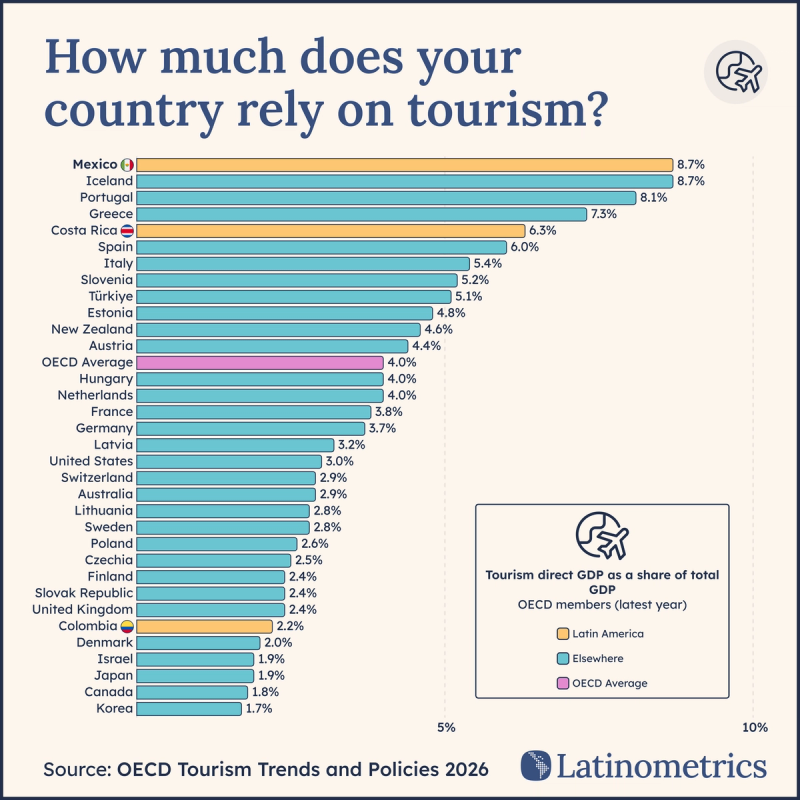
Mexico and Iceland rely on tourism more than any other OECD country, and Costa Rica relies on it more than Spain, the world's second most visited country.

On December 23, 2024, a group of friends from São Paulo landed at Bogotá's El Dorado airport on their way to Cúcuta and found officials and cameras waiting for them. One of them was Colombia's 6.2 millionth visitor of the year, beating 2023's record of 6.17M and making 2024 the best year Colombian tourism had ever had. How important does tourism have to be for a country to celebrate a single passenger?
In the OECD's ranking of tourism's share of the economy, two countries tie for first place at 8.7%. Iceland is home to fewer than 400,000 people and welcomed 2.3M international visitors in 2025, nearly six for every resident. Mexico gets there on sheer volume. It was the world's sixth most visited country in 2024, with 45M international tourists, and 2025 brought a record 47.8M, up 6.1%.
And Mexico wants to move up a spot. In June 2025, President Claudia Sheinbaum made it official in Plan México: fifth most visited country in the world by 2030, with 40% more visitors.
Three Latin American bets
Three of the 33 OECD countries with recent data are Latin American (Chile, the fourth Latin American member, hasn't reported a figure since 2019), and each tells its own version of the same story. Mexico is already at the top, Colombia's growth hasn't reached its GDP yet, and Costa Rica has stuck with one plan for decades.
Colombia set a record of 7.1M international arrivals in 2024, up 14.6%, yet tourism is still just 2.2% of its economy, near the bottom of the OECD. Then 2025 got bumpier. Total non-resident visitors fell 8.1% to 6.5M because visits from Colombians living abroad dropped 34%, while foreign visitors still grew 3.8%. Even so, tourism already brings in about half of Colombia's service exports.
Costa Rica shows what three decades of one strategy can build. Tourism makes up 6.3% of its economy, fifth in the OECD and ahead of Spain. Since 1999 it has earned more foreign currency than bananas, pineapple and coffee combined, and in 2024 it set a record of 2.6M tourists by air and $5.4B in foreign exchange on the back of its ecotourism brand. That brand now has a luxury tier. September's MICHELIN Guide hotel selection counts 23 Key hotels in Costa Rica, including Nekajui (a Ritz-Carlton Reserve), the only hotel in the Americas newly promoted to the top rating of Three Keys.
Mexico knows how to host
An economy built on visitors has its frictions (in 2025, anti-tourism protests reached Mexico City), and it depends on the world wanting to travel. Coffee and copper can sit in a warehouse until prices improve; wanderlust can't. What brings people back is how they're treated, and that's where Mexico shines.
This summer, Mexico hosted 13 World Cup matches without a single security disruption. "Today the world is talking about how well the matches were organized in Mexico," said Rodrigo Martínez-Celis, FIFA's executive director for safety and security in the country. Most places tourists visit, from Cancún to Los Cabos, have homicide rates at or below those of big US cities. Those who stay longer agree. In InterNations' 2025 Expat Insider survey, expats ranked Mexico first in the world for culture and welcome.
Making a guest feel at home is second nature in Mexico's service culture, and it may be the country's most valuable tourism asset. As any Mexican host will tell you, mi casa es su casa.
Source: OECD Tourism Trends and Policies 2026. Latest available year (2023 or 2024).


