
Which Latin American stock market is biggest relative to GDP?
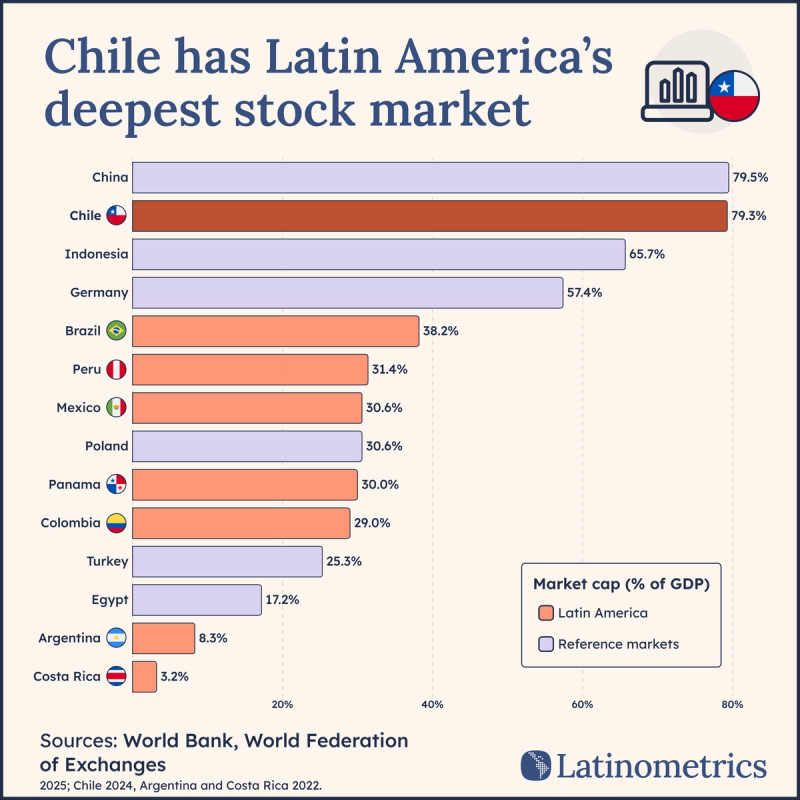
Santiago’s exchange is worth nearly 80% of Chile’s economy, twice Brazil’s ratio and on par with China’s, according to 2024-25 World Bank data.

Close to 12 million Chileans own a piece of the stock market whether they think about it or not: the pension accounts they’ve paid into since 1981 hold Chilean shares alongside everything else.
Now, while the two most famous exchanges worldwide, the NYSE and Nasdaq, are based in New York, Latin America’s stock markets are also worth a look.
Latin America’s stock markets
Ever since the Salvador stock exchange opened in northeastern Brazil in 1817, the region has had a number of key hubs where investors could trade shares of publicly held companies.
And while you’ve probably heard of the B3 in São Paulo or Mexico City’s famous BMV, what you might not know is that Chile’s stock exchanges are really carrying their weight.
Add up what every company listed in Santiago is worth and set it against the size of Chile’s economy, and the ratio lands above anything Frankfurt or São Paulo can show, and within a whisker of Shanghai, as this chart built on World Bank and World Federation of Exchanges data reflects.
Chile’s stock-market successes
Founded in 1893, the Santiago Stock Exchange, Chile’s main bourse, is third in market capitalization within Latin America.
Santiago’s ticker board is bigger than Chile. Falabella and Cencosud run stores from Lima to Buenos Aires, LATAM Airlines flies more passengers than any carrier in the region, and SQM is the world’s second-largest lithium producer. Those four alone are roughly 12% of the entire Chilean market, and they earn across the region while the economy they’re measured against is Chile’s alone.
Not bad for a country with roughly a tenth of Brazil’s population, especially given that Chile’s main equity index outperformed the S&P 500 in 2025.
Part of the story is that arithmetic: regional earnings measured against a single country’s GDP. Part of it is history: when the government sold off Endesa, Entel, and the phone company in the late 1980s, the young AFPs (the private pension funds) were the buyers with cash, and they anchored the local market for decades.
Chile has also taken that market on the road with its Pacific Alliance partners. With Colombia and Peru, it built the Mercado Integrado Latinoamericano (MILA) in 2011; Mexico joined three years later. Chile, Colombia, and Peru have since gone further and merged their exchanges outright into nuam, whose single trading platform is already live in Bogotá and Lima and is due in Santiago before year-end.
The timing matters. Chile’s 2025 pension reform will push another 7% of wages into the system over the coming decade, just as its exchange plugs into Bogotá and Lima. How much of it stays home will decide whether Chile keeps this title.
Source: World Bank, World Federation of Exchanges. Latest available year; Chile 2024, Argentina and Costa Rica 2022.


