
Who attracts the world’s foreign tech investment?
Every country is racing for the data centers behind the AI boom. Few are landing the investment that actually builds tech industries.

As any of our longtime readers have surely realized by now, not all investment is created equally.
Sure, a new gold mine opening in Colombia is great, but a new car factory employing Colombians is better. A foreign multinational just acquired a Brazilian soy producer? Not bad, but it would be even better if that company was investing in a Brazilian startup and bringing some tech transfer and skills training.
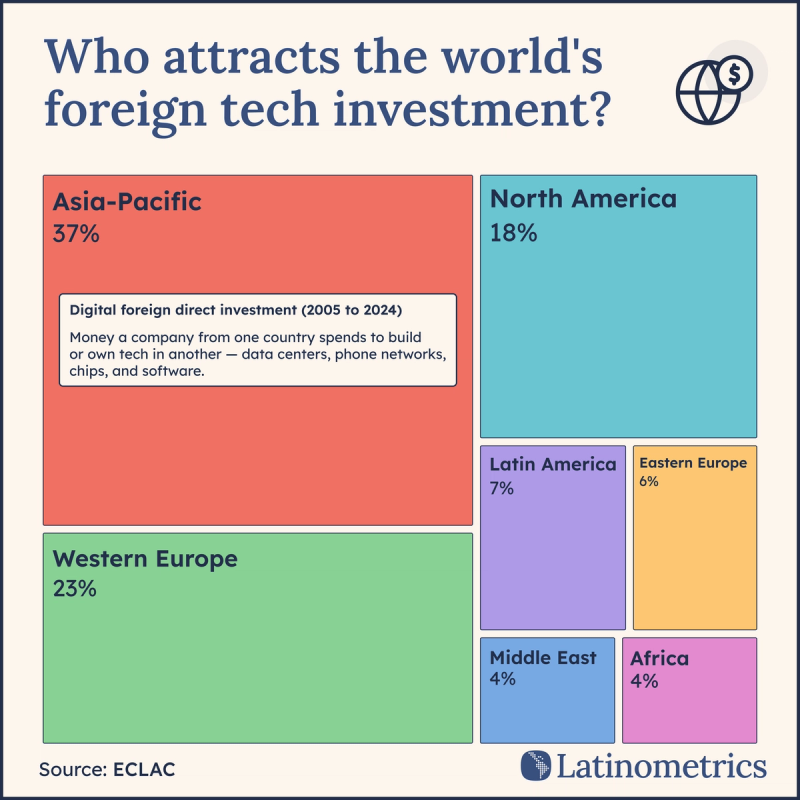
Of course, attracting foreign direct investment (FDI) is like your favorite Rolling Stones song: you can’t always get what you want. This chart maps digital FDI worldwide between 2005 and 2024, drawing on a recent report from the United Nations Economic Commission for Latin America and the Caribbean (ECLAC).
At first glance, Latin America’s thin slice looks like a snub. Except 7% is roughly the region’s share of the global economy, and it pulls in closer to a tenth of all foreign investment worldwide. The money shows up, and lately in record amounts: digital-investment pledges to the region hit a decade high of $20 billion in 2024. The problem is what kind.
The Wrong Kind of Digital
Worldwide, the biggest share of digital investment (about 40%) goes into production: the chips, the engineering, the high-value work that builds lasting capability. In Latin America, production gets just 14%. Two-thirds of the region’s digital FDI flows instead into infrastructure: data centers and networks, the server sheds that keep multiplying across the region but employ only a few dozen people apiece once the concrete dries.
Who attracts the world’s foreign tech investment?
The shape of it is telling. The three biggest digital investors in Latin America over the past five years, Amazon, CloudHQ, and Microsoft, are all in the business of building those server farms. A decade ago the leaders were telecom operators like Telefónica; today they’re hyperscale cloud companies, and the buildings they leave behind draw down local power and water faster than they build local know-how.
Who Runs the World? Firms
Maybe losing out on the productive kind of digital investment makes you shrug, either because you work in another sector or because you’d be happy with anything that meant no new data centers in your town.
But which kind of investment a country lands today shapes what it can build tomorrow. As new technologies and AI reshape the global economy, developing regions like Latin America cannot afford to fall behind their peers. Targeted investment in the right sectors—the kind that transfers skills and seeds local industry—can play an outsized role in keeping Latin Americans competitive.
For proof, look only to Intel’s multi-decade presence in Costa Rica, making up at times a fifth of local exports and nearly five percent of the country’s GDP. Prior to Intel’s drawdown of local operations in 2025, the company had helped boost Costa Rican productivity and know-how through billions of dollars in investment, at a time when Latin America as a whole struggled to compete with peers in Asia or Europe.
“When it comes to international politics, you’re either at the table or on the menu,” and the modern digital world is similar. Latin America must level up the regional economy by attracting the right kind of international investment, to ensure the region’s competitiveness in the decades to come.


