
Almost 60% of Bolivia's seniors are still working
Bolivia's seniors work past 65 at double the rate of Uruguay, exposing stark regional divides.

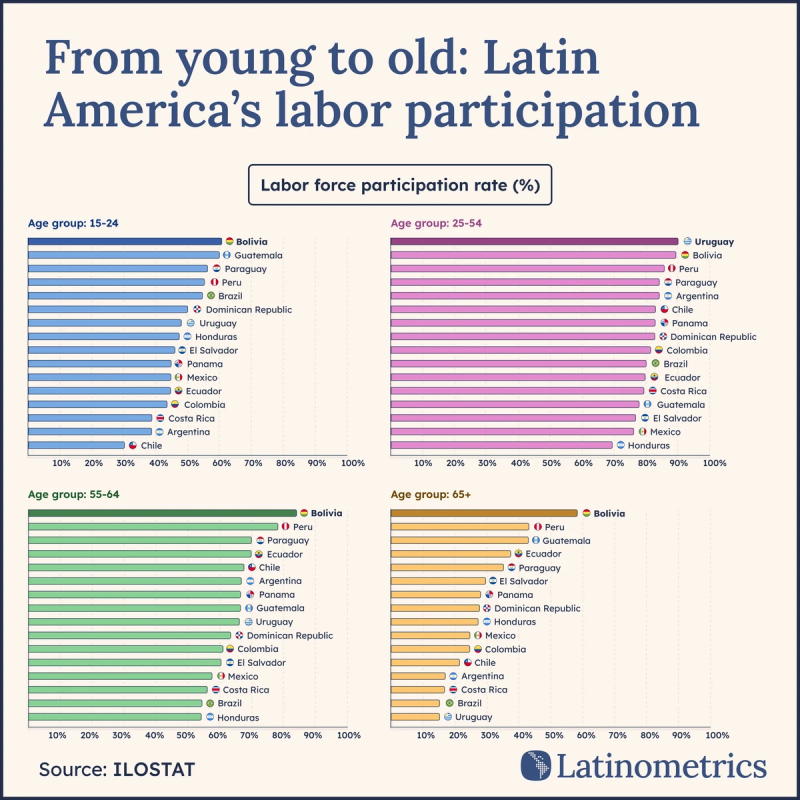
Almost 60% of Bolivia's seniors are still working.
When did you get your first job? Eighteen? Fifteen? Ten? Have you ever even worked?
As it turns out, the answer you provide may well depend on your country of origin—after all, Bolivian teenagers appear to join the workforce in higher proportions than anywhere else in the region. Once they do, they’ll stay working well past their counterparts in the rest of the region: over half of Bolivians above 65 years old are still working.
And this is from a country which has been regularly cited to have serious issues in child (and forced) labor in sectors ranging from mining to agriculture to even picking chestnuts.
Contrast this with our regional show-off, nearby Uruguay, in which nine in ten citizens in their prime working years (25-54) are in the labor force, yet this ratio reverses when dealing with the elders. Consider this a reflection of the powers of quality education, decent wages, and an enviable pension system which keeps retirees off their feet (for the most part).
From young to old: Latin America's labor participation
We talk a lot here at Latinometrics about the seismic shifts happening in post-pandemic Latin America and the Caribbean. Since 2016, the region is estimated to have created 27M new jobs, yet widespread informality and limited social protections remain critical issues for citizens and governments alike.
In this light, youth unemployment is down by over five percentage points over the last decade, yet 20% of young people are in that dreaded NEET (not in employment, education, or training) category. Women have outperformed men in post-2016 employment gains, yet continue to face stubborn gender wage gaps which suppress their income growth.
And tomorrow’s workers of Latin America must not only consider at what age they’ll retire, or whether their job will be in services or a high-productivity industry. With the arrival of generative AI, an estimated 2-5% of regional jobs face the risk of being automated away. An additional 17M jobs may lose out on well-needed productivity gains owing to existing digital infrastructure gaps across the region’s rural, lower-income, and more vulnerable areas.
Putting aside Túlio’s delivery of the message, the point is well taken: How can US Latinos, who represent a massive economic force, help Latin America? Are they willing to do it?


