
Breaking down Brazil and Argentina's $31B trade
Cars and trucks make up 43% of the $31B in goods Brazil and Argentina traded in 2025, even as the two governments pulled ambassadors.


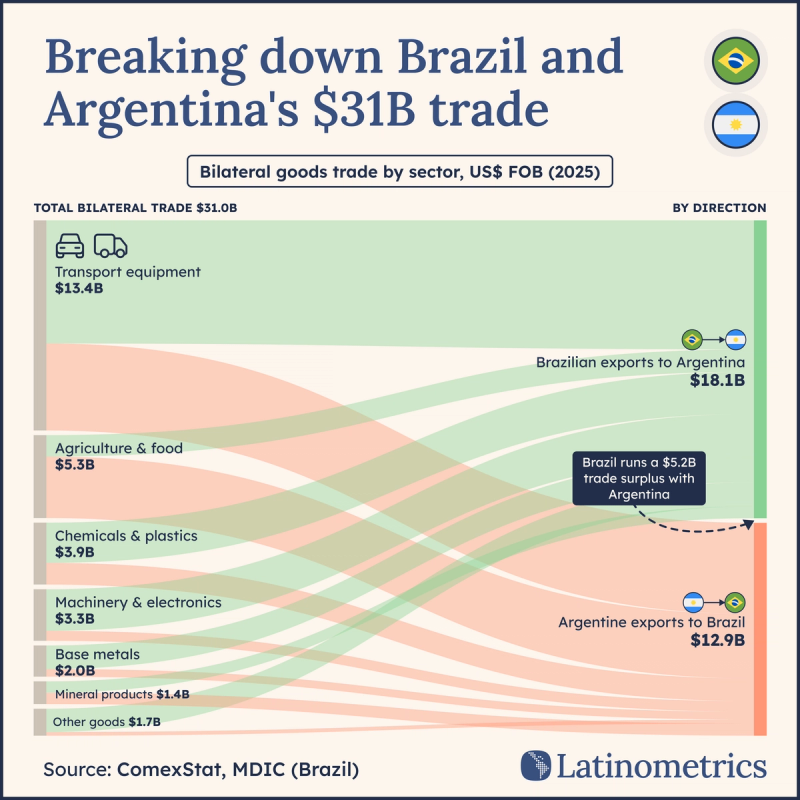
This month, Brazil pulled its ambassador out of Buenos Aires and handed the embassy to a chargé d'affaires. It's the lowest the relationship has gone in recent history, and it started with Javier Milei calling Lula a thief at a Bolsonaro campaign event, then repeating it on Argentine television.
But the invisible hand doesn't care about two very large egos.
That pairing is the biggest in Latin America. We covered the rest of the ranking last week; today let's open up the number-one pair itself, sector by sector.
Bilateral trade exceeded $31B in 2025, with Brazilian exports to Argentina up more than 30%. And in five of the seven goods sectors that make up the relationship, Brazil sold more than it bought.
Looking to Beijing
Brazil anchors seven of the ten largest trade relationships in Latin America and runs a surplus in each of them, Argentina included. The country's industrial base allows it to sell more to its neighbors, which mostly supply raw materials in return, than it buys from them.
But even if Brazil is at the center of most of Latin America's major intraregional trade relationships, the country's most important business lies elsewhere. In 2024, Brazil exported nearly $96B in goods to China, its top trade partner since 2009. This is almost double the total amount, $48B, Brazil sold to every other Latin American country combined.
And unlike its industrial exports to the rest of Latin America, Brazil mostly sends commodities like oil, soy, and iron to China.
What Crosses the Border
With Argentina, the pattern flips. Almost three-quarters of what Brazil buys from its neighbor is either a vehicle or something edible, and the rest of the import basket thins out quickly from there.
What Brazil sends back is a broader list. Machinery and electronics, chemicals and plastics, and base metals each carry real weight alongside the vehicles, which is the shape you'd expect from the larger industrial economy in the pair.
| Sector | Brazil → Argentina | Argentina → Brazil | Total |
|---|---|---|---|
| Transport equipment | $7.8B | $5.5B | $13.4B |
| Agriculture & food | $1.4B | $3.9B | $5.3B |
| Chemicals & plastics | $2.6B | $1.4B | $3.9B |
| Machinery & electronics | $2.6B | $0.6B | $3.3B |
| Base metals | $1.5B | $0.5B | $2.0B |
| Other goods | $1.5B | $0.2B | $1.7B |
| Mineral products | $0.7B | $0.7B | $1.5B |
| Total | $18.1B | $12.9B | $31.0B |
Source: ComexStat, MDIC (Brazil), 2025. Exporter-reported FOB values; 21 HS sections collapsed into 7 sectors.
An Automotive Pact
The most-traded goods in both directions in 2025 were vehicles, specifically cars and trucks from Argentina and cars and auto parts from Brazil. No other sector comes close on either side of the ledger.
Toyota alone ships half of Argentina's vehicle exports, led by Hilux pickups built in Zárate. The best-selling import moving the other way is also a Toyota, the Yaris, assembled in Brazil. Volkswagen and Stellantis run the same loop, building on both sides and selling into both markets.
That integration is a vital artery for both nations. Brazil is Argentina's main trading partner, absorbing around 40% of its industrial exports; conversely, Argentina is Brazil's third-largest partner behind only China and the United States.
A vehicle assembled on the outskirts of São Paulo might run on a gearbox built in Córdoba. The spats may make the headlines, but the supply chain is rock solid.


