
Latin America's biggest trade relationships
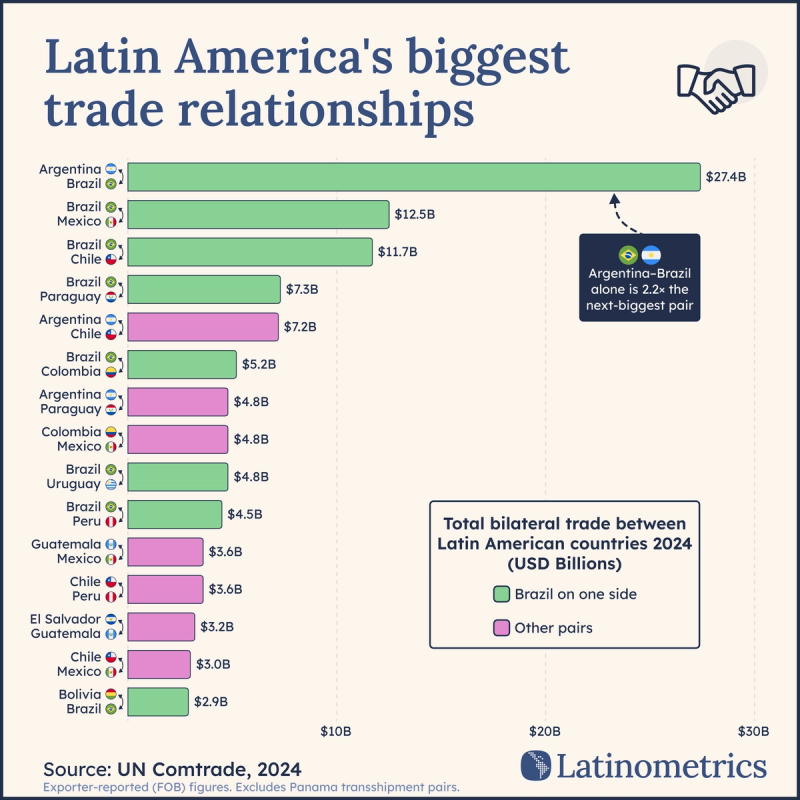
Brazil anchors seven of Latin America's ten largest trade pairs in 2024, while Mexico and Chile send most of their exports to the US and China.

If you sell B2B, you’re usually seeking the C-suite’s attention. We believe there’s no better way to do so than with insights about their industry. And we have a track record to prove it (and help you execute).
Learn more
Last week, Brazil pulled its ambassador out of Buenos Aires and handed the embassy to a chargé d’affaires. It’s the lowest the relationship has gone in recent history, and it started with Javier Milei calling Lula a thief at a Bolsonaro campaign event, then repeating it on Argentine television.
But the invisible hand doesn’t care about two very large egos (or language barriers).
That pairing is the biggest in Latin America. Today let’s gauge the state of the rest, starting by acknowledging how little of it there is to speak of.
Intraregional trade accounts for barely 15% of the total exports from Latin American countries. In Asia, that figure approaches 50%, while in Europe it’s closer to 70%.
Led by Mexico, Latin America sends over 40% of its goods north to the US. There’s a clear beneficiary of relatively low intraregional trade in Latin America, and it doesn't speak Spanish.
Looking to Beijing
Brazil is involved in seven of the ten largest trade relationships in Latin America and runs a surplus in each of them. The country’s industrial base allows it to sell more to its neighbors, which mostly supply raw materials in return, than it buys from them.
But even if Brazil is at the center of most of Latin America’s major intraregional trade relationships, the country’s most important business lies elsewhere. In 2024, Brazil exported nearly $96B in goods to China, its top trade partner since 2009. This is almost double the total amount, $48B, Brazil sold to every other Latin American country combined.
And unlike its industrial exports to the rest of Latin America, Brazil mostly sends commodities like oil, soy, and iron to China.
Latin America’s Top Trade Partners
Beyond Brazil, the region's other major economies also look elsewhere. Mexico appears in only two of the top ten intraregional trade relationships because the country sends over 80% of its goods exports north to the United States.
Even Chile, which connects the two giants, has its sights set further afield—specifically, across the Pacific. Chile is the only country outside Mercosur that trades heavily with both Argentina and Brazil. Yet Santiago’s biggest customer is China, which in 2024 accounted for nearly 38% of Chilean exports.
While most eyes look outward, one bond remains strong beyond soccer. The number-one pairing is essentially an automotive pact between the two major Mercosur economies.
Argentina–Brazil Auto Trade
Source: UN Comtrade (2024). Exporter-reported (FOB) figures; excludes Panama transshipment pairs.
The most-traded goods in both directions in 2024 were vehicles, specifically cars and trucks from Argentina and cars and auto parts from Brazil.
That integration is a vital artery for both nations. Brazil is Argentina’s main trading partner, absorbing around 40% of its industrial exports; conversely, Argentina is Brazil’s third-largest partner behind only China and the United States.
Despite all of the above, the relationship kept growing past the 2024 figures in the chart. Bilateral trade exceeded $31B in 2025, with Brazilian exports to Argentina up more than 30%. A vehicle assembled on the outskirts of São Paulo might run on an engine manufactured in Córdoba. The spats may make the headlines, but the supply chain is rock solid.


