
🍿 Cinépolis
Why did Cinemex go bankrupt twice in the US while Cinépolis became the world's largest cinema chain?
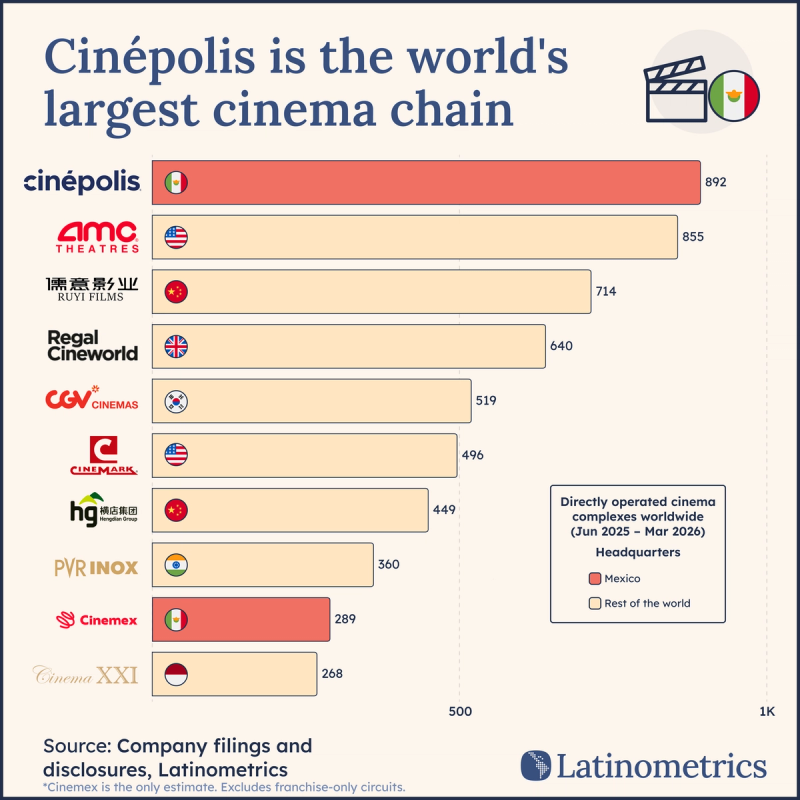
The world's largest cinema chain started with a single screen in Morelia.
In 1971, on Santiago Tapia street in Morelia, Enrique Ramírez Miguel and his son opened a theater and called it Cine Morelia. One screen, one projector, one provincial city.
Back in 2023 we covered how two Mexican brands ranked among the world's largest movie theater chains. The picture has since changed. The company born in that provincial theater now runs more cinema complexes than anyone else on Earth (AMC still has more screens; nobody has more locations).
Its most recent expansion took Cinépolis to the Persian Gulf. It started with Bahrain in January 2019 and followed with Oman four months later. That same year it won one of the first licenses to operate in Saudi Arabia, which had banned cinemas for 35 years, and announced six complexes with 63 screens. Today it operates in 19 countries.
To understand how a company from Michoacán ended up in Riyadh, you have to look at the market where it learned the trade.
Sells like a powerhouse, charges like an emerging market
Mexico is the world's fourth-largest movie market by tickets sold (203 million a year across 7,512 screens), ahead of Japan, France, and the UK, according to Canacine's 2025 report built on Screen Digest data. Rank the same markets by box office revenue and Mexico slides to eighth, with $745M, or 2.3% of the global total.
One number explains it. A ticket costs $3.70, the eighth cheapest among the world's major movie markets.
That cheap ticket may be part of the formula behind the chain's success. Anyone looking to make money there builds neighborhood chapels instead of cathedrals. Lots of them: small, close to where people live, and full. It's the same playbook OXXO ran with corner stores, and it's how a Michoacán chain learned to make a cheap ticket pay.
When the ticket is cheap, the business is somewhere else
If each ticket leaves so little margin, you have to make money around the ticket. That's why, in July 2026, Cinépolis launched a credit card with Openbank, Santander's digital bank, and Mastercard. It's the chain's first card, and Openbank's first co-branded card anywhere in the world. No annual fee, you apply from your phone, and up to 16% back in club points on Cinépolis spend.
The card lands in a market where nearly two thirds of adults have no formal credit, and Openbank wants it to be the first card many young people ever hold. It's the same door the financial apps already opened, as we showed last year, when Argentine and Brazilian fintechs began to outpace Mexico's traditional banks in downloads. The difference is that this time, the one knocking is a movie theater chain.
The Mexican counterexample
Cinemex, the other Mexican name on the chart, tried the opposite. In 2017 it crossed into the United States with CMX Cinemas and bet on a handful of very expensive complexes, with chef-run kitchens and in-seat service. When theaters closed in March 2020, revenue went to zero and the rent kept coming due.
It went bankrupt in April 2020, emerged in December, and filed again in July 2025. The pandemic was the trigger, but the problem outlasted it. The US box office fell from nearly $12B in 2018 to $8.6B in 2024, and the leases were still priced for a world with more seats filled.
The two brands left Mexico with the same question and answered it differently. One went where tickets are expensive and signed leases just as expensive. The other stayed where it's cheap and learned to make that enough. One ended up in bankruptcy court twice. The other tops the chart. The next test is Riyadh, where a ticket costs several times what it does in Morelia.


