
🌮 Tortillería Economics
A tortillería in Puebla sells 20% more than three years ago. The bank still said no.
A tortillería walks into a bank
Picture a tortillería in Puebla that now sells 20% more than it did three years ago, thanks to new customers, higher prices, and two new hires. Looking to open a second location, the owner walks into a bank to apply for a loan, and they ask for collateral she doesn't have, financial statements she never kept, and a credit history she never had the chance to build. She walks out without the loan. The second location will open anyway, but only with whatever the register leaves behind.
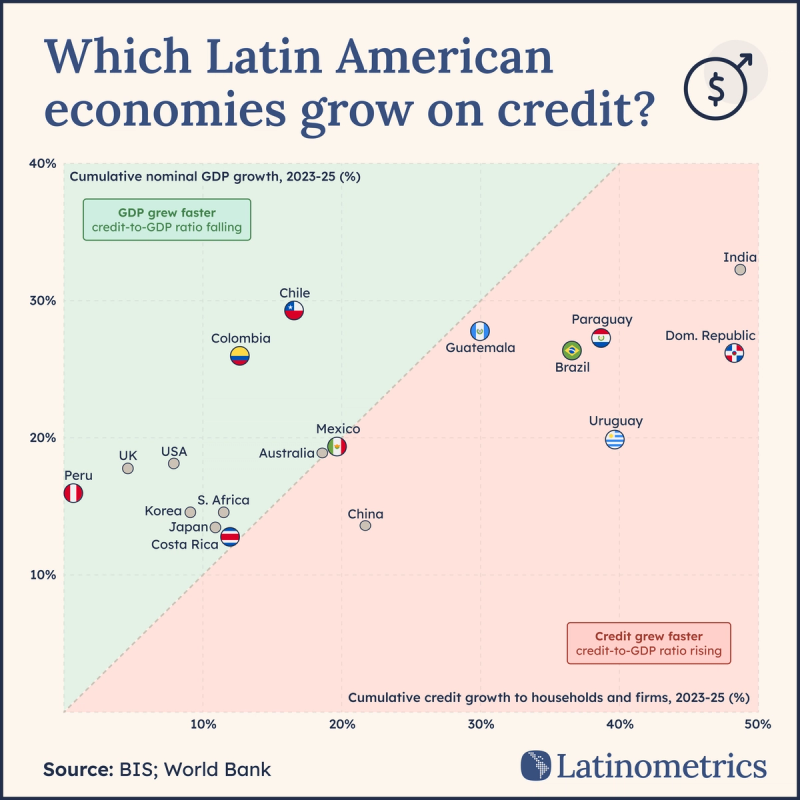
That scene, repeated millions of times with different variations, is what shows up when you plot credit growth against GDP growth over the last three years.
In the chart, a diagonal marks the point where both move at the same pace. Above it, the economy grew faster than its debt. Below it, credit grew faster than the economy. And as we can see, Latin America doesn't all fall on the same side.
Chile has the banks, but companies stopped borrowing
Chile sits well above the line, with nominal GDP up 29.3% cumulatively while credit rose just 16.6%. That slow credit growth relative to GDP has little to do with a missing financial system; if anything, Chile has one of the deepest credit markets in the region as a share of GDP. The issue is that fewer and fewer companies are walking in to ask.
If the tortillería were in Santiago, the bank would most likely have said yes.
Looking closer, once you strip out inflation, Chilean banks have been lending less money every year since 2023, and the drop is concentrated precisely in business loans, which fell about 5% in September 2024 and over 4% in March 2025, according to the CMF, the country's financial regulator. As the Central Bank points out, companies simply aren't applying for credit.
Mexico never had much credit to lose
Mexico lands almost exactly on the line, with credit up 19.7% against 19.4% for GDP. Both grew at the same speed, which sounds healthy until you realize how small the credit pile was to begin with. Mexican companies access, on average, half the credit as a share of GDP (25%) that their peers in the rest of the region do (47%). Of the country's 5.4 million micro, small, and medium-sized businesses, which account for 71% of national employment, only 4.4% obtain bank financing, according to INEGI's 2024 economic census.
The tortillería in Puebla and an auto plant in Monterrey compete in two different systems that happen to share a country.
Brazil did grow with credit, but an expensive kind
Brazil is on the other side of the line, alongside Paraguay, Uruguay, Guatemala and the Dominican Republic, where credit outran the economy. The financial system did make that growth possible, but the steep cost it carried is hard to ignore.
When a Brazilian can't pay off the full credit card bill, the outstanding balance starts accruing interest. In 2023 those rates averaged nearly 450% a year, the highest level since 2017: a debt of one thousand reais could become five thousand in twelve months. With households in a critical spot, putting close to 28% of their monthly income toward debt payments, the government launched Law 14.690 in January 2024. The law backed the "Desenrola Brasil" program, designed to make renegotiating liabilities easier and to fight delinquency, and it also set a cap: credit card interest can no longer double the original amount of the debt.
The gray dots show the pattern holds outside the region too: India and China grew on credit, while the US, the UK, Japan and Korea grew without it. What sets Latin America apart is the spread. Peru sits further above the line, and the Dominican Republic further below it, than any economy outside the region.
Two ways to grow
Growing without credit is neither a virtue nor a flaw. It means different things depending on where you start.
Chile grows without credit because its companies stopped asking for it. Mexico, because it never had anyone to ask. Brazil did take it on, and pays for it like few places in the world.
Credit can be a ladder that gets you to higher places but it doesn't build the business. For the owner of the tortillería, that diagonal decides one thing: whether the second location opens this year or four years from now.


