
High gas prices are nothing new for Mexicans
US and Israeli bombs couldn't move a Mexican pump price.

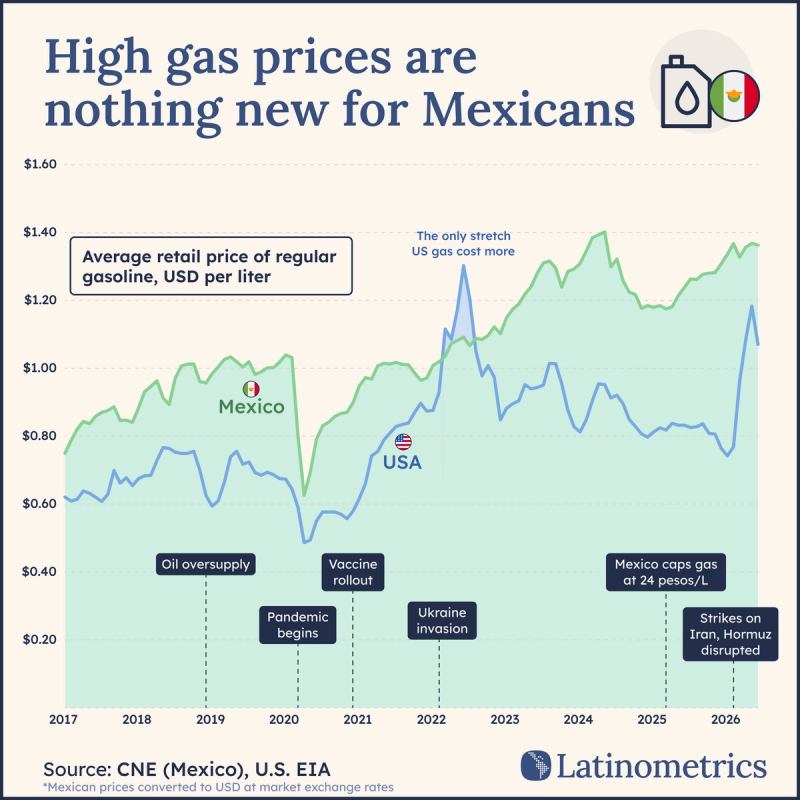
When the US and Israel struck Iran and the Strait of Hormuz was blocked, American gasoline futures posted their largest monthly jump on record: 30% in March alone, with roughly a fifth of the world's oil trapped behind the strait. Across the border, almost nothing happened.
Between February and June 2026, a liter of gasoline in Mexico moved from $1.367 to $1.363. Four thousandths of a dollar, and in the opposite direction for anyone expecting a jump to match the one up north. By the May peak, filling a 40-liter tank had gotten about $17 pricier in Texas, and about one US quarter pricier in Monterrey. The explanation is the voluntary price ceiling of 24 pesos per liter, signed in February 2025 and renewed in March 2026 with 96% of the country's gas stations. But a price cap is like a glass ceiling: it keeps the hail off your head, but when the sky clears, it also keeps out the breeze.
Texan gasoline, Mexican prices
Start with where the fuel Mexicans burn actually comes from. Mexico buys nearly all of its imported gasoline from the United States: an average of 446K barrels per day in 2025, according to EIA data compiled by Bloomberg Línea. Against domestic production of about 390K barrels per day, that means more than half the gasoline sold in Mexico crossed the border first. And that's despite a shrinking dependence: purchases from the US fell 5% in 2025, their third straight year of decline.
Pemex still imports more than it produces, and Mexico has a long road ahead before it gets anywhere near energy independence.
There's a harsher way to read those prices. At Mexico's minimum wage of 315 pesos a day, a liter costs about 36 minutes of work. At the US federal minimum, about 9. Four times the work for the same liter.
The shock absorber works both ways
As the conflict at Hormuz dragged on and the American price spiked, the Mexican price stayed glued to its 24-peso ceiling. The government even extended the scheme to diesel in late March. For consumers, the outcome could hardly be better. Sooner or later, though, the context will change.
The companies in the middle are living the strangest version of this. FEMSA's OXXO Gas, the country's second-largest station network with more than 550 stations serving some 330,000 drivers a day, signed the pact alongside Petro Seven, Hidrosina, G500, and thousands of independents under Onexpo. They buy gasoline at prices set in Houston and sell it at a price set in a February handshake.
But a cap that cushions the way up also cushions the way down. When crude normalizes (and at some point it will), the American price will fall with the market, while the Mexican one may well stay put.
A third of the green line isn't gasoline
One more detail worth pausing on: if the peso has been this strong, why does Mexican gasoline keep looking more expensive on the chart? Because comparing two countries in dollars measures two things at once, the price of the fuel and the currency it's priced in.
From January 2017 to June 2026, the Mexican liter rose 82% in dollars but only 48% in pesos. The peso is simply strong nowadays.
A stronger peso accounts for roughly a third of the climb in Mexican gasoline's dollar price. And the phenomenon is still alive. As long as the peso holds, Mexican gasoline will keep getting more expensive in dollars even if nothing moves a centavo at the surtidor.
| Moment | USD/liter | MXN/liter | MXN per USD |
|---|---|---|---|
| Jan 2017 | $0.749 | $16.00 | 21.35 |
| Apr 2020 (Covid) | $0.625 | $15.18 | 24.27 |
| May 2024 (superpeso) | $1.402 | $23.53 | 16.79 |
| Jan 2025 | $1.180 | $24.26 | 20.57 |
| Jun 2026 | $1.363 | $23.67 | 17.37 |
Source: CNE (Mexico); monthly average exchange rate. Peso prices reconstructed from the dollar series.


