
Guyana is catching up to its oil-rich neighbors fast
Why Venezuela finally showed up to fight a 127-year-old border controversy at The Hague, just as Guyana struck it rich.

Last month, Venezuela’s acting president, Delcy Rodríguez, was in the Netherlands. This may come as a surprise—after all, ever since her predecessor was snatched by the United States in January on drug trafficking charges, Rodríguez has been busy trying to avoid his fate.
She’s been pushing legislation to liberalize the national oil sector and toeing the line set by the White House on political prisoners. What could have possibly brought her halfway across the world to The Hague, Netherlands?
Probably the only thing that ever brings anyone to The Hague: the International Court of Justice (ICJ), which was hearing arguments over the long-running territorial controversy between Venezuela and neighboring Guyana. Guyana brought the case to the court back in 2018, and for years Venezuela refused to participate, denying the ICJ’s jurisdiction. Only now, with the process going against it, is Caracas showing up: Rodríguez personally attended the hearings as her country’s side presented arguments that the Essequibo region of Guyana is actually a Venezuelan state.
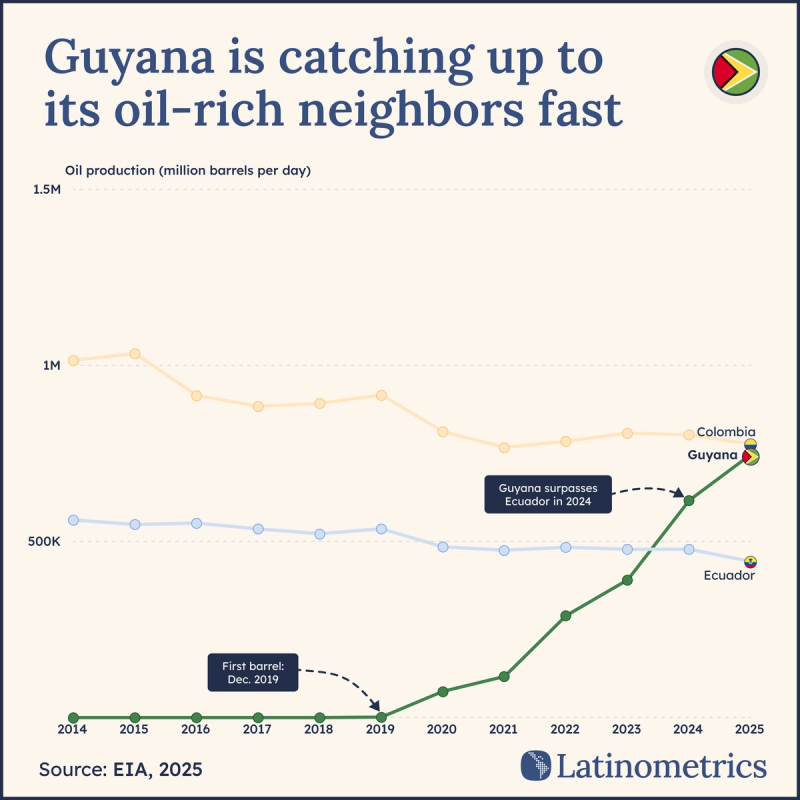
And given this chart on Guyana’s oil production, which incorporates annual data from the Energy Information Administration (EIA), we’re not overly surprised that Caracas is interested.
After all, Guyana is oil rich now too.
A Century-Old Conflict
The controversy over the Essequibo region, which makes up over half of Guyana’s total land area, is at once an old one and a very new one.
Guyana is catching up to its oil-rich neighbors fast
The two sides inherited their claims to the land from colonial powers, the Spanish on Venezuela’s side and the British and (ironically) Dutch on the Guyanese side. In 1899, an international arbitration panel ruled in Guyana’s favor, which put the matter to rest for a few decades. In the 1960s, however, Venezuela’s leaders began to clamor for the land once more.
The calls only got louder when massive oil deposits were discovered off the shore of the Essequibo region in 2015. An old colonial controversy now held geostrategic and economic weight.
An ExxonMobil-led consortium started pumping in 2019. In the years since, Guyana has become the world’s largest oil producer per person, ahead of petrostates like Kuwait and Qatar. The small Caribbean country of fewer than a million people is also the world’s fastest-growing economy, with GDP expected to expand by at least 16% this year. This staggering figure still trails the 43.5% growth seen in 2020 alone.
Venezuela’s Oil Gluttony
With a front-door view of all this black gold, Caracas wants in. Under Rodríguez’s predecessor, strongman Nicolás Maduro, Venezuela formally created a state in the region in late 2023. The country also spent much of 2024 flexing its military muscle on the border, prompting concern not only from Guyana but also from countries like the US and Brazil.
Rodríguez is unlikely to make a move that could land her in hot water with Washington, especially not right now. But her government continues to argue the ICJ has no jurisdiction over the case. And she would hardly be the first Latin American leader to make a play for disputed territory in order to stir nationalist sentiment and avoid political transition.
Of course, Venezuela hardly needs Guyana’s few billion barrels of oil. The country famously has the world’s largest reserves of crude petroleum. While Guyana will not be passing heavyweights like Brazil anytime soon, Venezuela’s problem has never been too low a supply. Effective governance and competent policies for the oil sector—these are the things that no amount of saber-rattling will ever deliver.
| Country | Production (barrels/day) | Share of Latin America |
|---|---|---|
| Brazil | 4,655,066 | 43.2% |
| Mexico | 1,869,381 | 17.3% |
| Venezuela | 1,007,615 | 9.3% |
| Argentina | 983,537 | 9.1% |
| Colombia | 776,912 | 7.2% |
| Guyana | 747,432 | 6.9% |
| Ecuador | 443,480 | 4.1% |
Source: U.S. Energy Information Administration (2025)


