
Peru's natural gas energy grew 10x since 2000
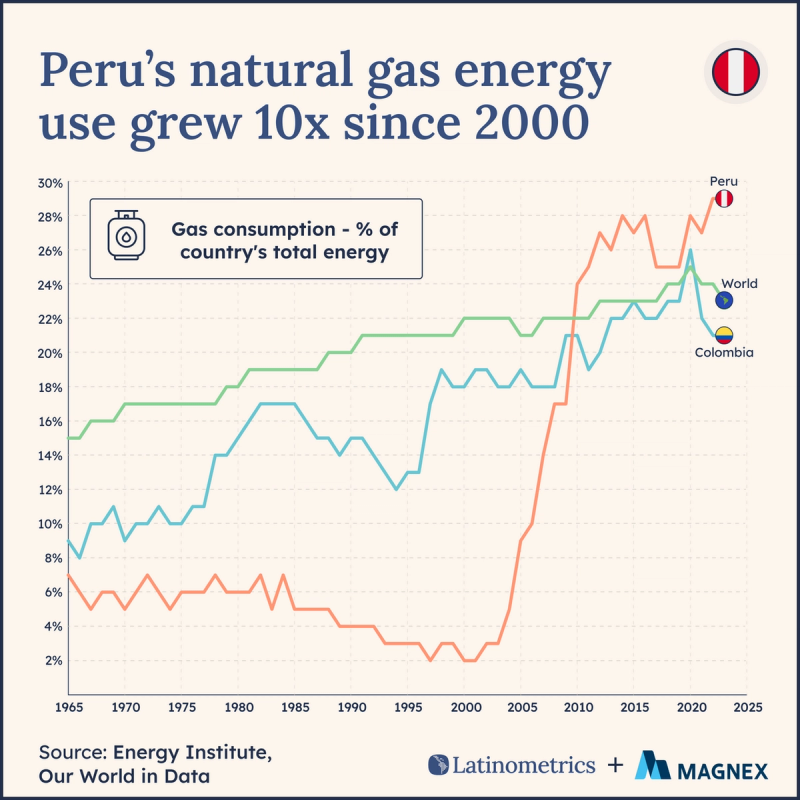
Peru's natural gas energy grew 10x since 2000, now supplying 30% of its energy needs.

Latin America is the land of hydrocarbon heavy-hitters. From Brazil and Mexico to Venezuela, oil and gas have long played important roles in the region’s major economies.
Peru is no exception. South America’s third-largest country has today a dynamic natural gas industry, the result of decades of investment and ingenuity and over 15T cubic feet of proven reserves.
In 2010, national authorities inaugurated Peru LNG, a $3.8B natural gas liquefaction plant roughly 180 kilometers southeast of Lima. The first on the continent, this facility created over 30K jobs and positioned Peru as a regional leader in the regional liquified natural gas (LNG) sector—so long as firms could successfully transport the gas from remote regions to this Peru LNG delivery point.
Today, Peru is the world’s 21st-largest natural gas producer, and accounts for 96% of all LNG exports in Latin America. The sector has attracted plenty of attention from energy multinationals based in Argentina, Japan, South Korea, Spain, and the United States. And most of this success is undoubtedly fueled by the massive Camisea Gas Project in the remote Amazon Basin.
In fact, the pipeline that stretches from Camisea to the coast holds the Guinness World Record as the highest in the world, reaching over 4.9K meters above sea level in some sections. Transporting gas from the jungle to the coast is a scale of challenge that no other country has faced.
At the turn of the century, a mere 2% of Peru’s total energy consumption used natural gas. Within a decade, the country had surpassed not only neighboring Colombia by this metric, but the global average. Peru reached nearly 30% by 2023, an all-time record for the country.
This has big implications for reducing dependence on foreign energy imports: oil’s role in domestic energy consumption, for example, dropped from 73% a half-century ago to just 41% in 2023.
With the fifth-largest proven gas reserves – behind only Venezuela, Mexico, Argentina, and Brazil – in Latin America and engineering initiative in tapping these reserves, Peru is well-positioned to grow its status as an energy giant in the years to come.


