
Colombia's debt interest bill has jumped 68% since 2020
Colombia's debt interest now rivals healthcare spending.

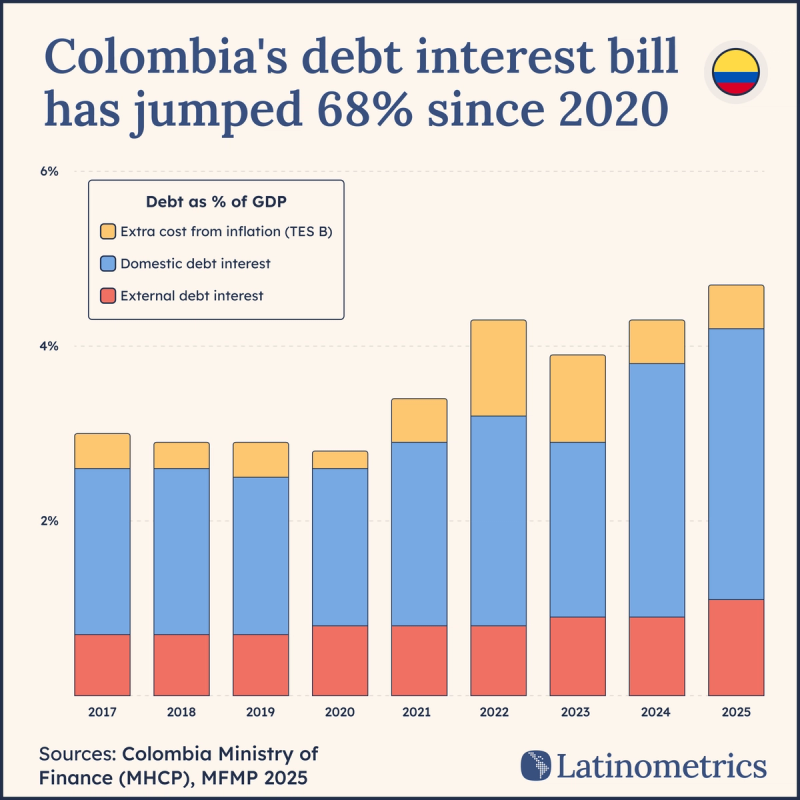
When you think of what your government spends on, what do you think of? Education? Healthcare? Wars in the Middle East?
For a growing number of governments, the honest answer is the most boring line in the budget: interest, on the debt accrued to pay for those schools, hospitals, and wars. And in Colombia, that line has nearly outrun everything around it.
Some countries (Brazil, the United States, most of Western Europe) have steadily worsening debt problems, driven by stubbornly high federal budget deficits. Others, like Guatemala or Peru, have been better able to meet their fiscal targets in recent years and are thus rewarded with less interest to pay each year.
Bogota's Post-Pandemic Debt Blues
And then there's Colombia, which has seen its debt interest payments jump since the pandemic. In 2020, total national debt servicing made up the equivalent of just three percent of gross domestic product (GDP). Half a decade later, these interest payments approached five percent of GDP.
Now, when we think of Latin American debt crises, our minds usually fly straight to dollar-denominated Wall Street bonds and the looming shadow of foreign creditors. But most Colombian debt interest is actually paid out to domestic bondholders, as external interest has barely budged in years.
Over the last decade, Colombia successfully shifted its borrowing away from foreign markets to finance itself locally, primarily through domestic treasury bonds known as TES. That shift left the country leaning on its own interest rates rather than the US dollar.
Inflation: It'll Leave a Mark
Like most countries, Colombia faced a nasty bout of inflation in the immediate aftermath of the pandemic as the global economy reopened.
Inflation hit 10.2% in 2022 and peaked at 11.7% in 2023 before beginning to decline.
When the central bank hiked interest rates to combat this inflation, the cost of refinancing local debt skyrocketed. A chunk of Colombia's local debt (the TES B bonds) carries an extra cost that rises directly with inflation, so when prices surged the government's bill on them did too, before easing in 2024.
Looking Ahead to Colombia's Debt Future
Compared to neighbors and peers like Argentina and Brazil, Colombia's debt scenario is far from catastrophic. However, with fiscal deficits outpacing economic growth, interest payments will continue to rise.
Take the draft 2027 budget, which needs to be voted on by the congress. This budget foresees a record $22.5B in interest payments on public debt, up over 30% from 2026. The spike represents the largest single-year increase on record.
Colombia escaped the dollar trap that has burned its neighbors for decades. It just discovered that debt borrowed at home still carries a price; it simply gets paid in a different currency.
How big of a bill is this for Latin America's fourth-largest economy? Well, it outweighs the roughly $20B to be spent on health next year. And while education expenditure was about 65% larger than interest spending in 2019, as of 2027 Colombia's government expects to spend roughly the same amount on both.
| Year | Total interest | External debt | Domestic debt | Extra cost from inflation (TES B) |
|---|---|---|---|---|
| 2017 | 3.0% | 0.7% | 1.9% | 0.4% |
| 2018 | 2.8% | 0.7% | 1.9% | 0.3% |
| 2019 | 2.9% | 0.7% | 1.8% | 0.4% |
| 2020 | 2.8% | 0.8% | 1.8% | 0.2% |
| 2021 | 3.3% | 0.8% | 2.1% | 0.5% |
| 2022 | 4.3% | 0.8% | 2.4% | 1.1% |
| 2023 | 3.9% | 0.9% | 2.0% | 1.0% |
| 2024 | 4.3% | 0.8% | 2.9% | 0.5% |
| 2025 | 4.7% | 1.1% | 3.1% | 0.5% |
Source: Colombia Ministry of Finance (MHCP), MFMP 2025


