
How much does the 1% own in Latin America?
Uruguay, Mexico, Chile, and Brazil post the region's highest top-1% wealth shares, all above the US despite its so-called billionaire class.


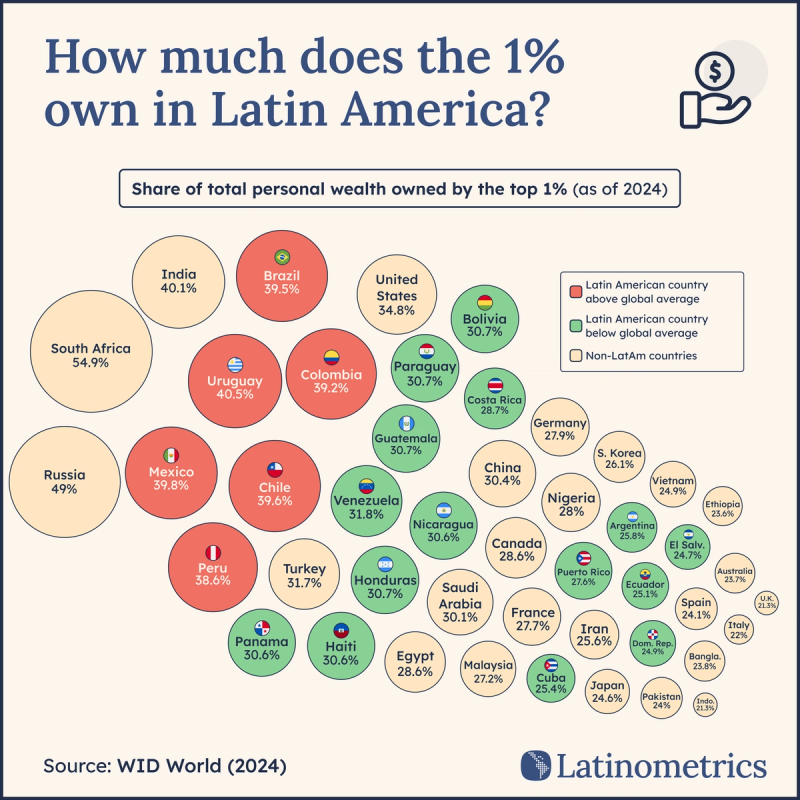
There's no way to sugarcoat it: with all the wars, pandemics, and recessions of the past decade, global economic inequality has only gotten worse. And perhaps nowhere is this more true than in Latin America, named the most unequal region in the world by, among others, the United Nations and the IMF. The label has stuck despite real progress: the regional Gini coefficient fell from roughly 0.569 in 2000 to 0.511 in 2016, though those gains have since slowed.
That story, however, is usually told through income. Today we're turning to a different indicator, wealth inequality, using estimates from the World Inequality Database (WID). Wealth is harder to measure than income, and WID's estimates carry wider error bars than long-established metrics like the Gini coefficient, but they speak to something income can't: the generational and class structures that limit social mobility.
Because wealth inequality measures something different from income inequality (accumulated assets rather than yearly earnings), it tells a story that departs from the standard narratives about the region. Many of the countries known for high income inequality, like Brazil and Colombia (historically among the region's highest, with Gini coefficients of 0.503 and 0.544, respectively), do indeed show high wealth concentration too. But the two don't always move together: Uruguay, typically viewed as among the most equal and progressive societies in the Western Hemisphere (and one of the region's favorite success stories), holds the region's highest concentration of national wealth in the hands of its top 1%.
Taxes Without Teeth
Addressing inequality is not an easy feat for governments. One of the most powerful tools at governments' disposal for addressing inequality is fiscal policy: taxation and direct expenditures. However, Latin American countries face distinct challenges in leveraging fiscal policy to address inequality. Most notably, no country in the region collects taxes (as a share of GDP) at the levels seen within the OECD. This is driven both by tax structure (most countries in the region rely more heavily on value-added and sales taxes than on income or corporate taxes) and by high levels of informality across much of Latin America.
These relatively low levels of taxation mean fewer resources for direct income transfers, and countries across the region consequently fail to reduce income inequality to the degree seen within the OECD. Furthermore, studies show that in some Latin American countries, fiscal policy can actually exacerbate existing income inequalities. When governments lean on consumption taxes, poorer households surrender a larger share of their income at the register, and if cash transfers are too small to compensate, the poor end up as net payers. Researchers at the Commitment to Equity Institute have documented this in Brazil, where many low-income households pay more in indirect taxes than they receive back in transfers.
Further complicating matters, many governments in the region face genuine fiscal constraints. Public debt climbed steadily through the 2010s, and the pandemic made things worse: emergency spending of roughly 8% of regional GDP collided with collapsing revenues, pushing debt to levels not seen in decades. To the region's credit, and as we covered recently, Latin American governments have since shown more restraint than their developed-world peers, and debt ratios have come down from their 2020 peak. But most of the region's largest economies, from Brazil (91.4% of GDP) down to relatively frugal Chile (42.5%) and Peru (30%), still carry more debt than they did before the pandemic.
Enter the Populists
The need to rein in government debt comes at a time of rising social discontent. The lack of social mobility, increased economic hardship, persistent inflation, sluggish growth, pervasive poverty, and informality in the job market, among other factors that mostly affect middle- and low-income sectors, have given rise to populists on both the left and the right promising economic miracles. These leaders tap into this discontent and frame the complex economic challenges as solvable through simple, straightforward solutions. While they have taken divergent economic paths, their promised economic miracles are unlikely to be achieved without addressing inequality and wealth concentration—a politically challenging act.
Latin American leaders must make democracy deliver. Addressing wealth inequality through policies that create long-term, sustainable, and inclusive growth is key to neutralizing a major source of political tension. While tackling income inequality is important, this is not enough. The region's regressive tax framework, which leans heavily on value-added taxes, disproportionately affects lower-income households. Effective public policy will need to address not only current income inequalities, but the region's persistent wealth inequality. One option increasingly under discussion is taxing wealth itself. A recent study estimates that a minimum 2% tax on centimillionaires, roughly 3,000 people across seven of the region's largest economies, would raise approximately $24B a year. Whether such a tax can work in practice is still hotly debated, and the political obstacles are real. Uruguay's Frente Amplio is currently weighing technical proposals to raise revenue through an inheritance tax.
For Latin American leaders to break the cycle of populist promises and democratic decay, they will need to make democracy deliver despite fiscal constraints. The question of whether the wealthiest should help pay for it has so far been louder in Europe and the US than in the region itself, but it is creeping closer to home: Brazil used its 2024 G20 presidency to put a global billionaire tax on the agenda.
Source: World Inequality Database (2024)


