
How Popular are Latin America's Presidents?
Bukele boasts 90% approval, but many LatAm leaders stumble amidst protests and paralysis.


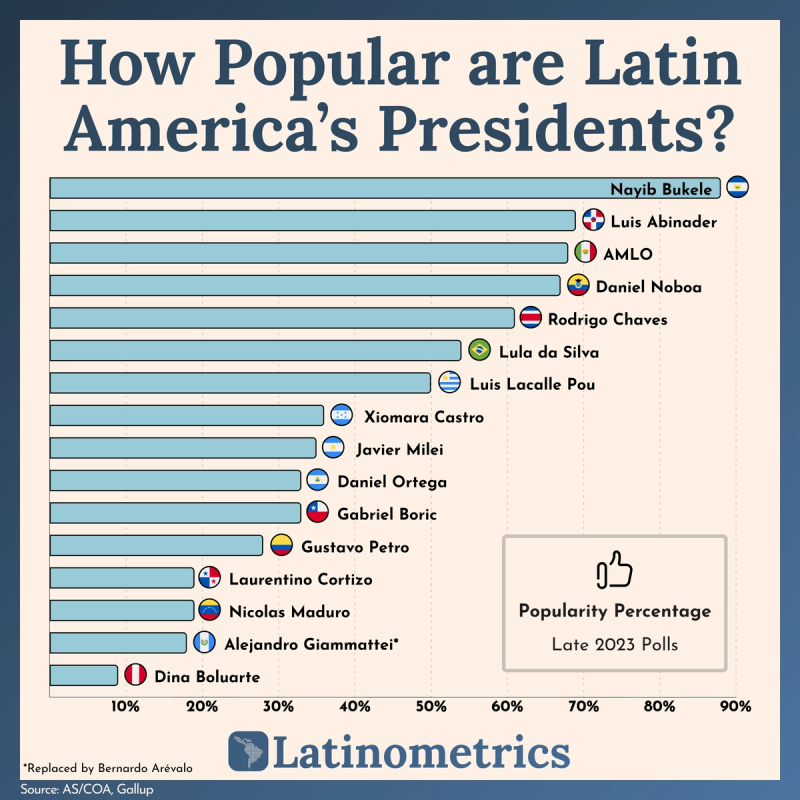
Nayib Bukele must be feeling pretty happy. Despite being originally barred by the constitution from running for immediate reelection, he’s widely expected to win this year’s presidential election in El Salvador by a landslide.
Does that surprise you? It shouldn’t. Bukele is perhaps the world’s most popular leader, with an approval rating just shy of 90%. At that level of popularity, you can get away with just about anything.
We know that Bukele owes his wide appeal to his government’s tough approach to crime. But what about his popular peers around Latin America? We’ve checked in with some figures from our friends over at the AS/COA to see how the region’s leaders are doing.
You might be Googling Luis Abinader right now, but not to worry: the Dominican president will also likely win reelection this year, so you have plenty of time to familiarize yourself with him and his performance.
Abinader has emerged as the most popular president in recent Caribbean history as a result of both his pro-business and anti-corruption policies. His government’s success in attracting foreign investment is particularly of note.
Meanwhile, rounding out the upper echelon of leaders are Daniel Noboa, still in his honeymoon phase as he tackles a crime epidemic as Ecuador’s new president, and Mexican President Andrés Manuel López Obrador (commonly known as AMLO). The latter is especially known for his strong ties to his supporters—but more on that later.
Then there are leaders like Lula da Silva or Luis Lacalle Pou. While both still keep a slim majority of approval, their political strength is less assured. Brazil’s Lula must consistently negotiate with a conservative congress to both pass policies and avoid repeats of last year’s coup attempt. Meanwhile, his Uruguayan counterpart has tried to dodge corruption charges that make his party’s loss of power this year likely.
Then there’s the remainder of Latin America’s leaders, who, despite stark ideological differences, face a common political malaise gripping the region in recent years.
Some like Chile’s Gabriel Boric or Colombia’s Gustavo Petro have had to shelf their biggest policy ambitions following defeat after defeat, while others like Peruvian President Dina Boluarte or Panamanian President Laurentino Cortizo are basically treading water in the face of widespread protests and civic unrest.
Excluding the autocratic regimes seen in both Nicaragua and Venezuela, the leaders in this third tier lack the political capital to truly enact any meaningful reforms. As a result, their countries face political paralysis, growing discontent, and economic stagnation.
Fears of each of these may explain why many of the most popular leaders on this list are also populists with a knack for communicating directly with their supporters. Bukele’s account on X is notorious, and not just because he reposts our charts.
Meanwhile, AMLO has found his own approach. The Mexican President is actually Hispanic America’s most popular individual streamer, with his infamously long press conferences being watched over any youth figure or gamer.
Part of this is the platform, of course, but part of it is just the man knowing how to speak to his people. Don’t believe us? AMLO’s party will likely win once more this year, while his chosen successor is expected to become Mexico’s first female president.


