
Latin America's democratic legitimacy is in freefall
As countries across the region struggle to fulfill the promises of democracy, fewer people are willing to defend it.

Most of Latin America today lives within some sort of democracy. And yet, the memory of authoritarianism still feels fresh across the region, especially as some look back fondly on the olden days.
In Argentina, the military dictatorship came to an end in 1983; in Brazil, in 1985; in Chile, in 1990. All of it followed a broader regional trend. Across Latin America, the late twentieth century was marked by a successive regional redemocratization. Since then, democracy has become the predominant form of governance across Latin America, with Cuba, Nicaragua, and Venezuela standing out as notable exceptions to a fairly established norm.
While this democratic triumph unfolded differently within each context, the common thread underpinning these transitions was the promise of a political system that could more effectively ensure accountability, provide stability, and promote prosperity.
Today, many feel as though this promise has gone unfulfilled. A newly published report from the United Nations Development Programme (UNDP) underscores the shortcoming of Latin American democracies in achieving full standards of political freedom and equality. As countries struggle to deliver on key issues like crime and basic services, more extreme leaders have been rewarded with higher approval ratings.
Latin America's democratic legitimacy is in freefall
In countries like Peru, where the last decade has seen over eight presidents cycle through power, and Brazil, where three of the last four presidents have been arrested once out of office, persisting corruption issues have understandably dampened popular trust in government.
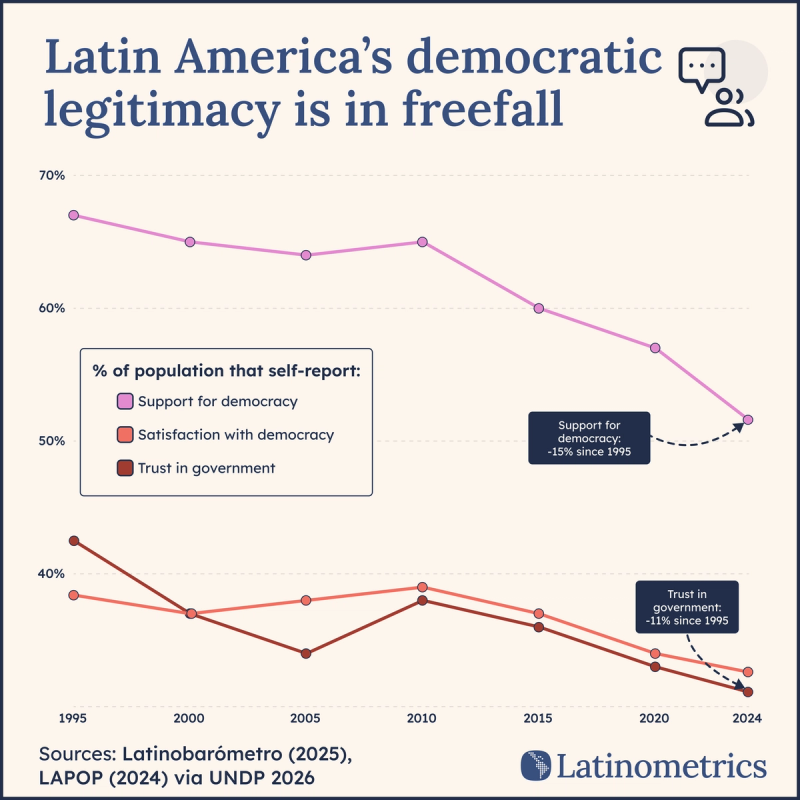
Less than half of Latin Americans expressed trust in their government in 1995 (understandable, given how recent the political transitions were at the time). Yet thirty years on, that share has dropped further to just 31% of the population.
Meanwhile, as the public's faith in institutions and leaders erodes, fewer people are willing to stand for democracy at all. In 1995, over two thirds of Latin Americans affirmed support for democracy; this number has fallen to just 52% today. Less than a third of Latin Americans are even satisfied with democracy.
Many of us who have grown up knowing Latin America as a region of democracies can be caught off guard by parents or grandparents who express nostalgia for less free moments of the past. Yet this sentiment often stems from exhaustion with stagnant economic conditions and political turbulence—reflecting a longing for stability and safety rather than repression.
| Year | Support for democracy | Satisfaction with democracy | Trust in government |
|---|---|---|---|
| 1995 | 67.0% | 38.4% | 42.5% |
| 2000 | 65.0% | 37.0% | 37.0% |
| 2005 | 64.0% | 38.0% | 34.0% |
| 2010 | 65.0% | 39.0% | 38.0% |
| 2015 | 60.0% | 37.0% | 36.0% |
| 2020 | 57.0% | 34.0% | 33.0% |
| 2024 | 51.6% | 32.6% | 31.1% |
Source: Latinobarómetro (2025), LAPOP (2024) via UNDP (2026)


