
Mexico's small lenders give up on 12% of loans
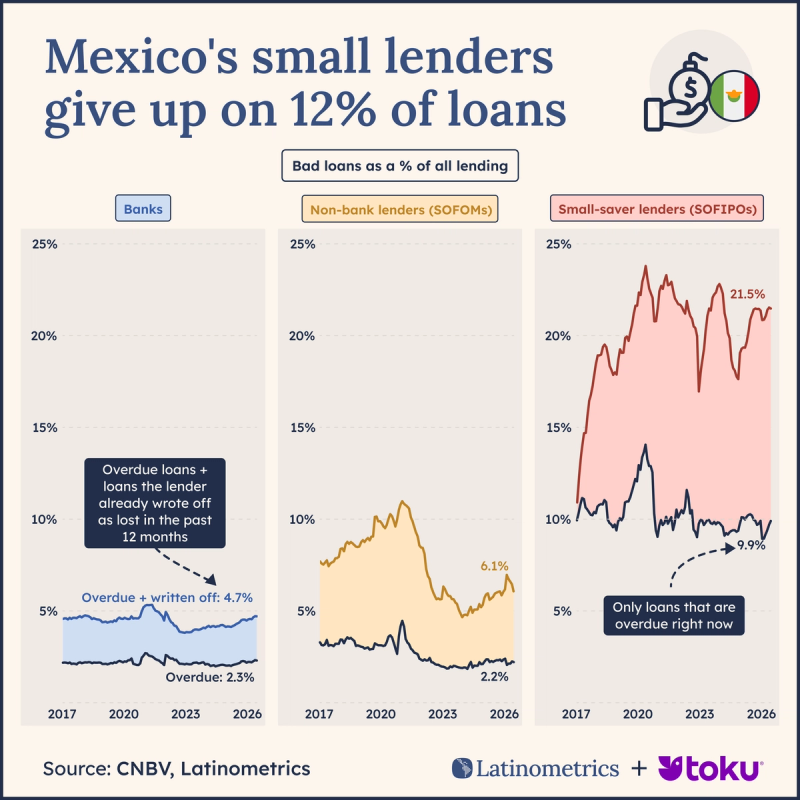
Mexico's small-saver lenders stop chasing roughly $686M a year in loans, per CNBV data, on top of what's overdue in 2026.


It's the fifth of the month. The kid's school tuition, car insurance, a loan payment and two subscriptions nobody remembers signing up for all come out of the same account on the same day. It all happens on autopay, so nobody has to think about it. Something came up two days ago and there's less in the account than there should be. Even though no one decided to stop paying, the charges hit. The loan bounces, turning that borrower into a statistic: overdue. A few months later, depending on how the lender collects and how the borrower pays, the same loan can turn into a second one: written off.
Multiply that bounced charge across Mexico's small-saver lenders and the money nobody is trying to collect anymore roughly equals $686M a year, on top of everything that's merely overdue today.
Two types of delinquents
Banks, SOFIPOs (the small-saver lenders, think Stori and Klar) and SOFOMs (the non-bank lenders, think Ford Credit and GM Financial) all split their bad loans into two piles for Mexico's banking regulator, the CNBV. The first counts the students who are failing, the loans behind on payments the lender is still chasing. The adjusted one also counts the ones who already dropped out, the loans it gave up on and erased from its books over the past twelve months.
Where lenders give up most
Banks' delinquency rose only a few tenths of a point in the first half of the year, partly because inflation and softer remittances are squeezing household income. It sounds like nothing. But the banks' loan book is so large that every tenth of a point is $495M in loans that stopped getting paid. The gap between their two lines, the part they've already given up on, is worth $11.9B a year.
Counting the dropouts, SOFIPO consumer loans jumped three points in a single year. Banks don't move like that. Their adjusted line hasn't left the same narrow band in the whole stretch the chart covers, pandemic included. Those three points are about $127M of consumer lending alone, on a book that is just 3% of the country's consumer credit.
SOFOMs sit in the middle. Most of what they lend is car finance, leasing and store cards, and a loan with a car behind it is probably easier to recover than a loan with nothing behind it. Miss enough payments and the lender takes the car back. That likely explains a good part of why SOFOMs' two lines run closer together than the SOFIPOs' do.
Beyond the very different borrower each group serves, how those loans get collected can be just as important. Take payroll loans, for example. The installment comes out of the paycheck before the money ever reaches the account, so unless the borrower loses the job, the loan gets paid on the dot. A recurring charge has no such guarantee. It only clears if the money is in the account on the day it hits. Part of what separates the three groups may be that one of them lends to people whose employers already do the collecting.
Delinquency by friction
The first time a lender chases a payment, it's usually just a reminder. Toku, which automates collections for companies in Chile, Mexico and Brazil, sees it every day: on the other end there's almost never someone who doesn't want to pay. Delinquency looks more like a card that expired and nobody updated, a charge that bounced on a Tuesday and was never retried on payday Friday, an email that landed in spam. A charge that retries on its own once there's a balance again never makes it to the uncomfortable phone call.
The question for anyone who bills on a recurring basis is how much of their own overdue portfolio is a plumbing problem before it's a risk problem.
How much of your delinquency is plumbing?
Toku automates collections, with up to 15 retries a month on a charge that failed and conversational agents answering borrowers 24/7. The free consultation is where you bring your own numbers.


