
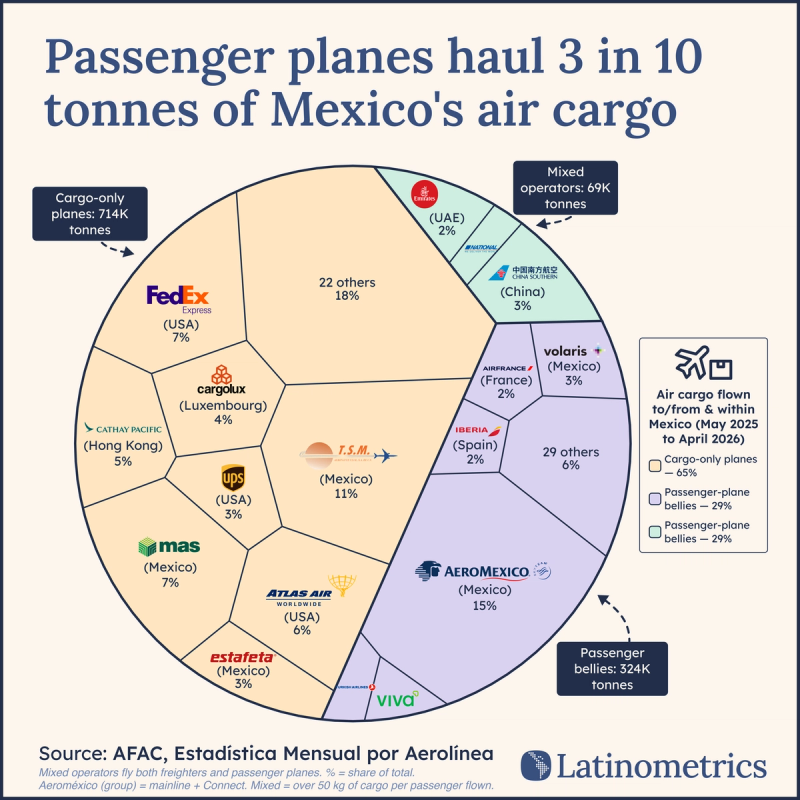
Passenger planes haul 3 in 10 tonnes of Mexico's air cargo
Inside Mexico's 1.1 million-tonne air cargo market: the top cargo airlines, freighters versus passenger bellies, and the nearshoring exports lifting it.


When you picture a country exporting massive amounts of heavy industrial goods, what do you see? Huge cargo container ships in the docks of harbors? Kilometers worth of truck lines awaiting to cross the border?
Well, as Mexico's manufacturing industry grows due to the nearshoring boom, the method to export these goods is unlike anything you're likely picturing: it lies in the empty spaces of commercial flights right beneath your feet.
When commercial airlines schedule flights for vacation travelers or business executives, these planes also have a fixed amount of lower-deck space — "belly cargo" — which companies can buy for their exporting goods. Right now, this unseen method is leading a major turnaround for Mexican exports.
Taxi, Takeoff, and Landing
Throughout 2025, Mexico faced trade disputes, global supply chain congestion, and international tariff pressures. Total air cargo volume thus contracted by 2.4%.
However, Mexico's Federal Civil Aviation Agency (AFAC) reported that during Q1 2026 the sector stabilized. Over 300K metric tons of goods moved by air, 6.5% more than in 2025. And almost three of every ten tonnes now ride in the bellies of passenger jets — a record, up from a pandemic low when bellies all but vanished. In total air cargo, domestic volumes fell 3.6% while international rose 12.7%, a sign the recovery is driven by cross-border demand.
The Passenger-Cargo Carousel
By early 2026, disruptions related to international trade policies began to ease, helping delayed shipments of industrial parts and intermediate goods move forward. Logistics managers have been taking advantage of the comeback of international commercial passenger flights to ship these away.
This has created a highly efficient carousel: high passenger volumes travelling towards Mexico, increased flight frequency, and the expansion of available belly capacity to export Mexican goods at a global level without the need of using dedicated cargo planes. Aeroméxico's group hauls the single largest share, and foreign carriers like Air France fill their bellies on the way back out.
Two Added Engines
Past World Cups drove 8–15% air traffic growth, and Monex expects Mexico to see a 4–6% increase during the 2026 tournament, generating US$1.8–3.0 billion in revenue. Higher passenger volumes also expand belly cargo capacity, supporting exports of electronics, automotive parts, and other intermediate goods.
Cargo traffic is being split across two major hubs, with Guadalajara (GDL) recording a 27.4% year-over-year increase to over 50K tons in April 2026, and Felipe Ángeles International Airport (AIFA) growing 17.4% to over 63K tons. AIFA's gains are reinforced by passenger-focused infrastructure such as the Buenavista–AIFA suburban rail link, cutting travel time to Mexico City to 50 minutes.
The ultimate outcome is a coordinated operational symphony across the entire logistics chain, driven by passenger density and its direct impact on export capacity. Mexico, one of the world's most popular tourist destinations, has resolved its accumulated inventory problems. As it turns out, passenger tickets are doing more than filling stadium seats, hotel rooms, and pristine cenotes. You are also making the process of bringing Mexican products to global markets more efficient.
Source: AFAC, Estadística Mensual por Aerolínea


