
The Citibanamex Rollercoaster Ride is Over
Citi's Mexico exit: Banamex's 138-year run ends, as institutional banking profits hit 49% margins.

Editor's note: This article was originally published in January 2022, shortly after Citi announced the Banamex sale. It reflects what was known at the time; the open question of who would buy Banamex was resolved in the years since.
Last week, Citi announced its plans to auction off Banamex. The bank justified the move as part of its plan to focus on its “institutional banking operations.” In other words, Citi will now only serve corporations with over $1B in revenues and the ultra-wealthy in Mexico.
In honor of a new chapter for Banamex, here’s a recap of some of its 138-year history:
1884 – Founded by a French banker
1968 – Launched the first credit card in Latin America
1982 – Nationalized by president López Portillo
1992 – Re-privatized by president Salinas de Gortari
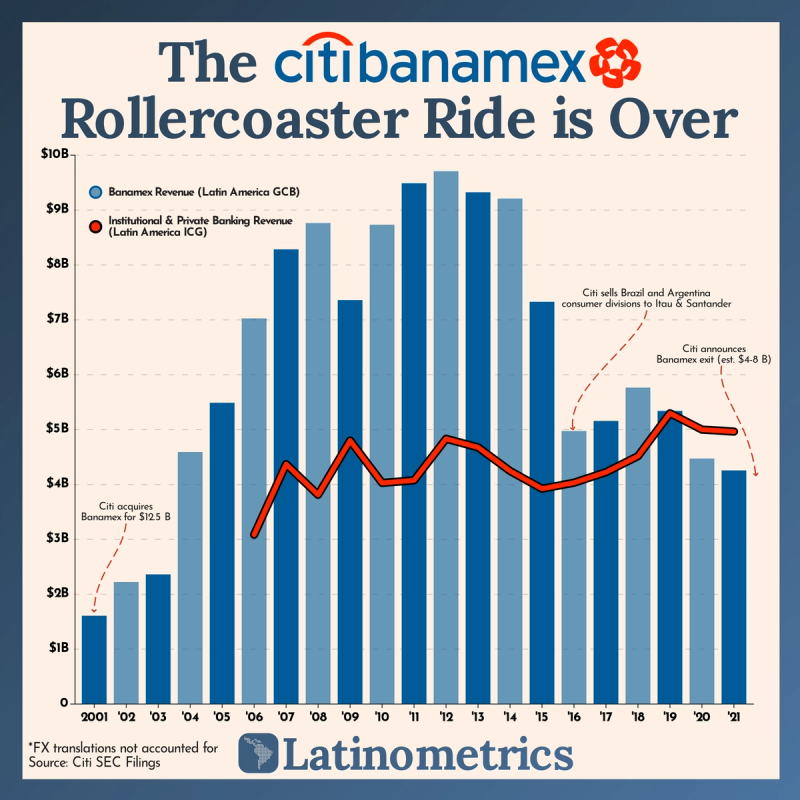
2001 – Acquired by Citigroup for $12.5B
2017 – Fined $97M by the US DoJ for enabling money-laundering
2022 – Now up for sale at an estimated $4-8B
We dug deep into Citi’s SEC filings and found that a Mexico exit makes a lot of sense. Not only does the company’s Institutional Clients Group (ICG) branch have much better margins than its Global Consumer Division (GCB – aka Banamex) in Mexico, but it also surpassed it in revenues for the first time in 2019. In 2021, ICG had a 49% profit margin, while GCB had only 19%.
In retrospect, we should’ve all seen this coming. Citi has been selling off its global consumer banks left and right: It sold its Brazil and Argentina banks to Itaú and Santander in 2016. We also suspect that the rise of modern competitors like Nubank, albo, and Clara, could’ve impacted this decision as Citi accepted a defeat in the consumer market.
The big question is now, who will buy Banamex, and what will its future look like? So far, the list of speculated buyers is diverse: Carlos Slim, Ricardo Salinas’ Banco Azteca, a Monterrey-based crypto company. President AMLO also expressed his wish to keep the bank’s Fundación Cultural, a highly valuable art collection, in Mexico.


