
What do Brazilians worry about most?
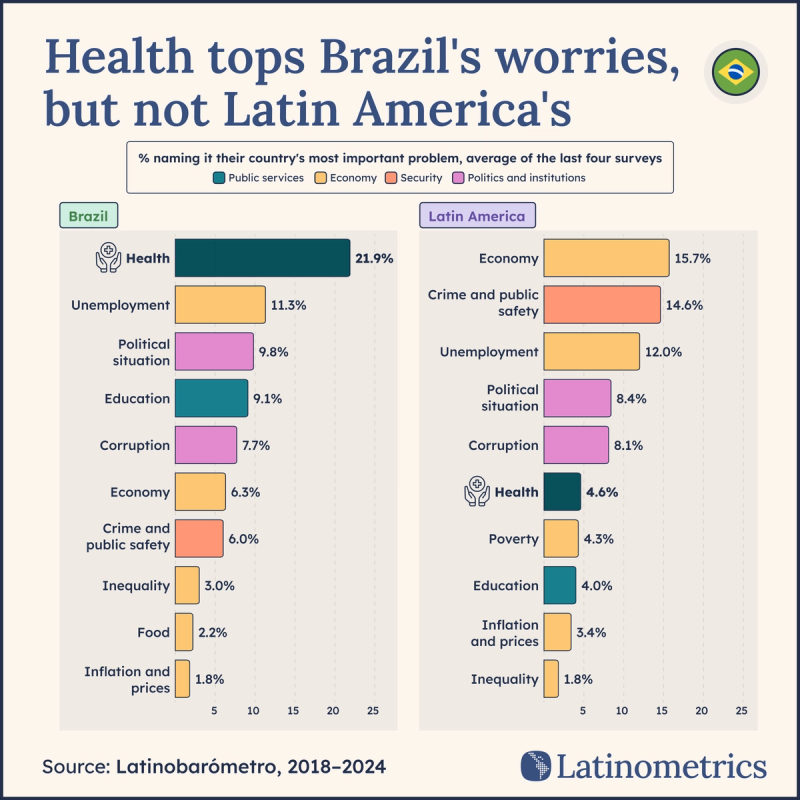
Brazilians worry most about health, their top problem in every Latinobarómetro survey since 2018, while the economy and crime lead across Latin America.

Bem-vindos de volta ao Brazil 2026 Elections Series! 🇧🇷
Last Sunday, 125M Brazilians went to the polls to choose their next president, among other legislative and executive officials. In Brazil, a candidate who wins more than half the valid votes takes the presidency outright; if no one does, the top two meet again in a runoff. Left-wing candidate Luiz Inácio Lula da Silva has finished in the top two in all 7 presidential races he has run since 1989. Yet, for the first time since 1998, he came second to another candidate.
With 47% of the vote, right-wing candidate Flávio Bolsonaro finished almost two percentage points ahead, contrary to most polls. Flávio received 5M more first-round votes than his father, Jair Bolsonaro, who lost to Lula in 2022.
No first-round leader has lost a runoff since Brazilians got their presidential vote back in 1989, though none led by less than five points.
But everything is possible in a country where voting is mandatory yet 33.5M, or 21% of the electorate, did not show up on Sunday. Meanwhile, 6M people voted blank or null, and 9.3M voted for candidates other than Lula and Flávio. That's far from a record. Blank and null ballots were just 4.8% of votes cast, close to 2022's low and about half their share in the 2006–2018 races. Brazilians who want to opt out can vote blank, vote null or stay home, and most of them stay home, which suggests those who do vote have largely picked a side.
So the race isn't over, and even if it were, whoever will lead next has some big challenges that we will continue to cover until the final round on October 25. One of those challenges is public health.
Brazil’s Unusual Health Problem
Latin America has no shortage of issues (we like to call them opportunities), but Brazilians are focused on an issue very different from the average Latin American's. In each of its last four surveys, from 2018 to 2024, Latinobarómetro found that Brazilians named healthcare as their country's most important problem. An issue that ranks far below matters like the economy and public safety for the rest of the region.
How is that possible in a country that offers universal healthcare? Created by the 1988 Constitution after two decades of military rule, Brazil’s Unified Healthcare System (SUS) provides everything from vaccination to organ transplants for 213M people, and the Health Ministry calls it the largest universal, free public health system in the world. Today, 76% of Brazilians rely exclusively on SUS instead of private insurance.
Well, tending to 213M people across 8.5M square kilometers, an area larger than the contiguous United States, is as complicated as it sounds. That population is also aging, with the share of Brazilians aged 65 and older rising from 7.4% to 10.9% between the 2010 and 2022 censuses. In the states that report their queues to the federal system, waiting times for specialist consultations reached an average of 57 days in 2024. If you know someone who's been seriously ill, you know this wait time can often mean life or death.
Life or death is the strongest motivator for change, so Lula's government has, of course, noticed the growing backlog. In addition to the 5.7M people waiting for specialist appointments, millions more are waiting for diagnostic exams and elective surgeries. In 2023, the federal government created a National Queue Reduction Program with $120M, then doubled its funding to $240M in 2024. The program pays states and cities a federal bonus for each extra surgery, exam or specialist visit, and by the Health Ministry's count it funded 649K surgeries in its first year, 133% of its target. But growth in surgeries slowed sharply in 2025, according to federal auditors.
Part of the problem is where the doctors are. Brazil has nearly 392K specialist physicians, or 184 per 100K residents, but they cluster in richer states and their capitals. The Federal District (home to the capital, Brasília) has 454 per 100K, while Maranhão has just 68, a gap of almost seven to one. In Amazonas, more than 95% of specialists are in its capital, Manaus.
In 2025, the federal government launched the Agora Tem Especialistas (“Now There Are Specialists”) Program to even out access to specialist care across the country. It prioritizes specialties where delays do the most damage, such as oncology and cardiology, and expands care through contracts with private hospitals, telehealth, longer operating hours and mobile specialist units.
Early results are mixed. SUS performed 7.5M elective surgeries in the first half of 2026, up 8% from a year earlier, by the Health Ministry's count. But the same June 2026 federal audit, which covers the program and its predecessors, found that while median waits fell for most common surgeries, the slowest quarter of patients waited longer for more than half of them. Its outpatient arm delivered 6.9% of the care planned for 2025.
Candidates’ Proposals
Despite having almost nothing in common, Flávio and Lula propose health policies with considerable overlap. It will probably boil down to who voters believe more on this issue.
So do the campaigns treat health as a top issue? More on paper than on the air. Both programs give public safety a chapter of its own. Flávio's spreads his health proposals across chapters on women, digital government, and education and care, while Lula's gives health a chapter too. In their first free-airtime radio broadcasts in late August, neither mentioned health.
Key: (first-round vote share per TSE, mini bio)
Flávio Bolsonaro (PL) (47%; chose Vasco over the Botafogo of his father, former president Jair Bolsonaro; Rio senator since 2019): wants to increase SUS capacity, raise what it pays hospitals and clinics to cover the real cost of care, and buy more exams and services from private providers during off-peak hours. He plans to expand telehealth so doctors in quieter regions can see patients waiting elsewhere, create one electronic health record shared by public and private networks, and use AI to speed up booking and flag people at risk of falling ill. He'd also expand the Family Health Strategy (community primary-care teams) and mental-health care, and deliver medicines at home to elderly, disabled and chronically ill patients.
Luiz Inácio Lula da Silva (PT) (45%; shined shoes at 12, ran a lathe at 14; sitting president, now going for a fourth term): wants to expand current federal programs, use AI to move the most serious cases up waiting lists, and make more medicines in Brazil. In practice, that means more doctors in underserved towns, community mental-health care, free dental care, free menstrual pads, care for mothers and newborns, free medicines, and shorter waits for specialists (partly by continuing to buy consultations, exams and surgeries from private hospitals). He also wants a single national electronic health record, more telehealth, more Family Health teams and a nationwide public cancer-care network.
While both Flávio and Lula promise shorter queues, better technology, and higher-quality care, neither candidate's program says how that will be paid for, or by whom.
| Problem | Brazil | Latin America |
|---|---|---|
| Health | 21.9% | 4.6% |
| Unemployment | 11.3% | 12.0% |
| Political situation | 9.8% | 8.4% |
| Education | 9.1% | 4.0% |
| Corruption | 7.7% | 8.1% |
| Economy | 6.3% | 15.7% |
| Crime and public safety | 6.0% | 14.6% |
| Inequality | 3.0% | 1.8% |
| Food | 2.2% | 1.2% |
| Inflation and prices | 1.8% | 3.4% |
| Poverty | 1.5% | 4.3% |
Source: Latinobarómetro. Share naming each their country's most important problem, average of the 2018, 2020, 2023 and 2024 surveys. Latin America pools 17–18 countries, Brazil included.


