
Latin America is proving factories can be green
How Latin American countries are decoupling factory growth from carbon emissions.


Siemens has over 300 factories worldwide. Their first ever to earn a “LEED Platinum” certification is none other than their Mitras plant in Nuevo León, Mexico: 40% less energy use, 800 MWh of solar power per year, and a new global benchmark for what sustainable manufacturing looks like.
More than a decade ago, the United Nations began implementing the Sustainable Development Goals (SDGs), 17 ambitious developmental objectives designed to improve people's lives worldwide by the year 2030.
Given the deadline is right around the corner, we figured we'd check in on how Latin America is doing in terms of advancing on the SDGs—and we figured we'd do so with our good friends over at Siemens, the largest engineering company in Europe and a respected manufacturing icon across Latin America.
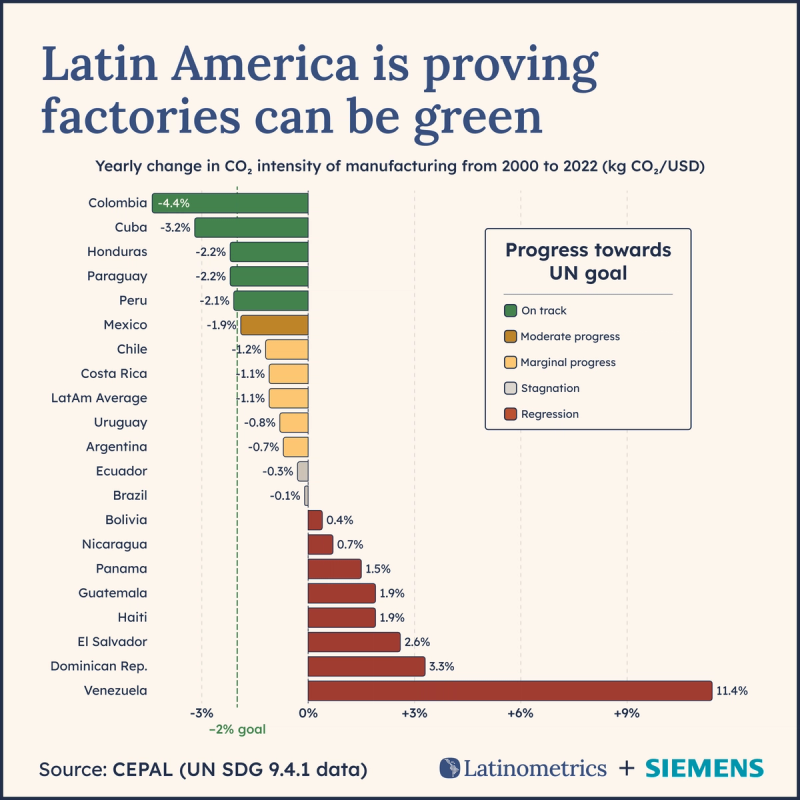
One way to measure this progress is with CO² intensity, or the "fuel efficiency" of a nation's economy: it measures exactly how much pollution is emitted for every dollar of value a factory creates. While the global goal is to improve this efficiency by 2% annually, Latin America's progress is a tale of two extremes.
Some nations are rapidly decoupling their industrial growth from their carbon footprint, including countries like Colombia, Costa Rica, and Guatemala which already have the cleanest factories in the region. Meanwhile, others are actually becoming more carbon-heavy as they scale up, highlighting a widening gap in the region's transition to a green economy.
A wide range of variables influence the amount of CO₂ emitted during manufacturing—from energy efficiency and production technology to the carbon intensity of power sources like hydro or solar. A prime example of this transition is Siemens' Mitras Factory in Nuevo León, Mexico, which recently secured its LEED Platinum certification. This milestone makes it Siemens' first worldwide to receive the distinction, setting a new global benchmark for sustainable and energy-efficient industrial facilities across the company's network.
And our region's countries now have greater motivation to make progress on this front, as carbon intensity becomes a trade variable. Starting this year, for example, the European Union's Carbon Border Adjustment Mechanism has begun explicitly tying market access to embedded mechanisms on key imports such as cement, iron and steel, aluminum, electricity, fertilizers, and hydrogen.
So a Mexican cement exporter, for example, must now declare the emissions involved in their production process and buy carbon certificates to make up the difference before their goods can reach the EU. This effectively levels the playing field, ensuring that CO² intensive imports can't undercut clean options, while providing a massive financial incentive for Latin American manufacturers to decarbonize.
With Latin America already generating approximately 60% of its electricity from renewable sources such as hydro or solar, the countries pushing manufacturing CO² intensity down fastest are also the ones best positioned to compete as more buyers start pricing carbon into supply chains.
2030 is fast approaching. Countries, off to the races.


