
Colombia trains talent but leaders are hard to find
Colombia ranks 32nd of 70 economies on employee training, ahead of the US, but 59th on finding competent senior managers, per IMD's 2026 survey.


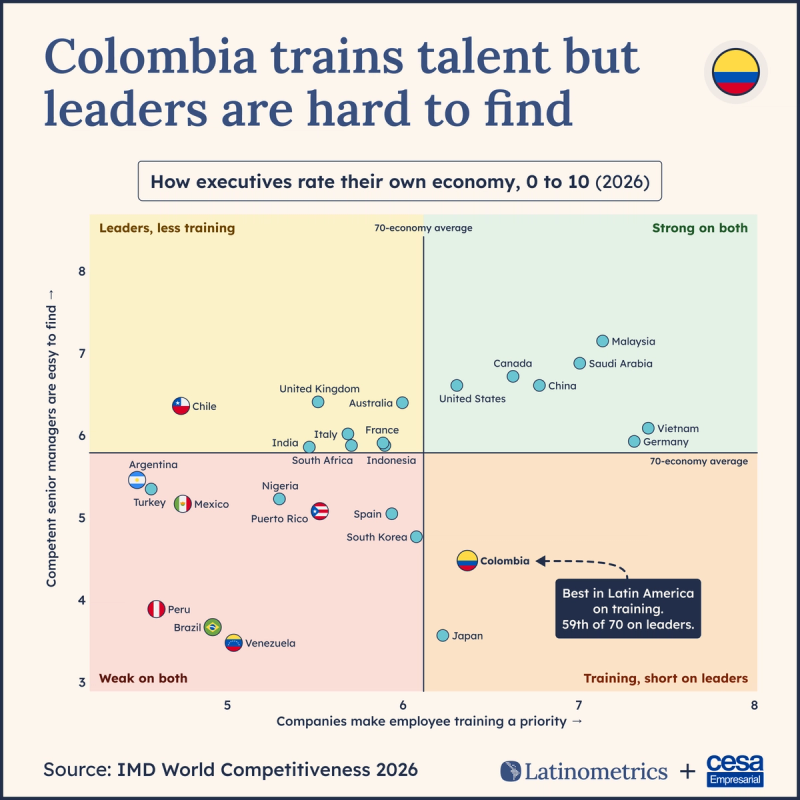
Colombian bosses give their companies' training a better grade than US bosses give theirs. So why are good leaders still so hard to find?
The country certainly knows how to produce them. Just ask Medellín's David Vélez, whose Nubank is arguably the most influential young company in Latin America. It's now Brazil's largest private financial institution by number of customers.
Back home, business leaders consider employee training a top priority in their companies, ranking Colombia 32nd of 70 economies. That puts it first in Latin America, a notch above the United States (33rd), per an IMD survey for its 2026 World Competitiveness Yearbook.
Ask those same leaders who could run the place, though, and the pride fades. On finding competent senior managers, they rank Colombia 59th of 70. Employers back them up, with 61% telling a different survey they struggle to find the people they need.
With leaders, the trouble is knowing what to look for. What makes someone a good leader? Think of someone you look up to, who got a team to achieve more than anyone thought humanly possible. Their skills are hard to name, and harder to find.
Where the shortage hits
A shortage of good bosses reaches the average Colombian, too. Nearly a tenth of the workforce is officially unemployed, and labor productivity has only grown by about 1% each year since 1990. Colombians put in the hours but get less out of each one than workers in Mexico or Chile.
Who is training future leaders?
Inflation or a jumpy peso can drag on output beyond any company's control, but who gets ready to lead is firmly in its hands. Companies that act on it start by asking: who is training our future leaders? Bancolombia, first in Merco Talento Colombia 2026, put 99.7% of its bosses through its own Leadership Institute in 2025.
Why not an expensive business degree in the US, or a cozy three-day retreat where managers can go enjoy warm cookies in the sun? Neither by itself builds a system where the best managers move up and train the people who will one day replace them.
Without such a system, a familiar story plays out. You may have witnessed it. A senior role opens up at your company. The person who has quietly kept the team running for years is told they aren't ready, and the job goes to an outside hire, who then spends their first months learning the business from the person who was passed over. The next leader was in the room all along, waiting to learn to think like one.
| Country | Training is a priority (rank of 70) | Senior managers easy to find (rank of 70) |
|---|---|---|
| Colombia | 32 | 59 |
| Brazil | 61 | 65 |
| Mexico | 63 | 52 |
| Chile | 64 | 26 |
| Peru | 67 | 64 |
| Argentina | 69 | 48 |
Source: IMD World Competitiveness Yearbook 2026, Executive Opinion Survey. Rank among 70 economies; 1 = best.


