
Is Brazil getting safer?
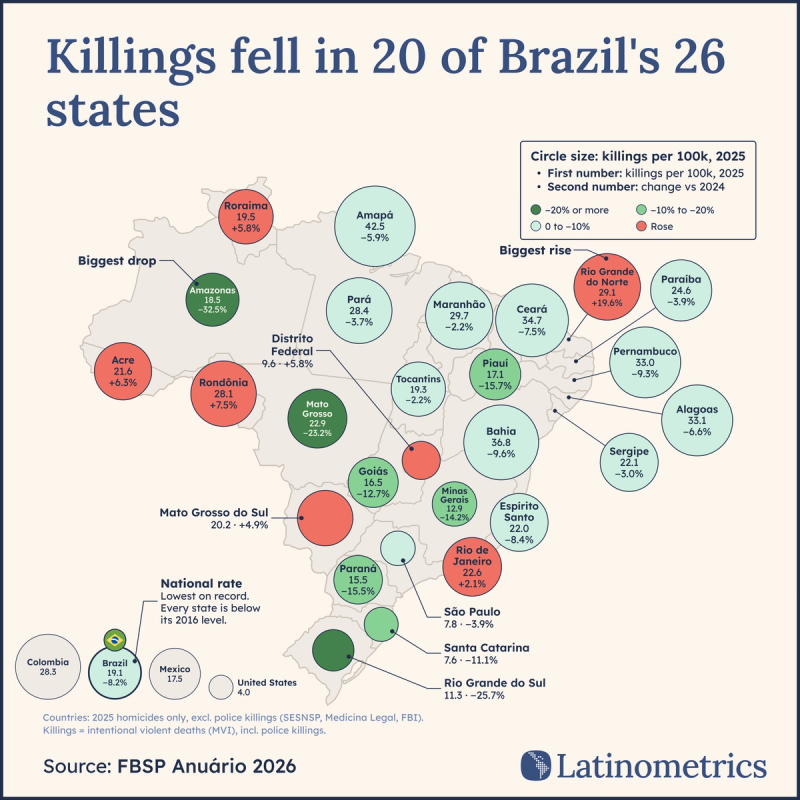
Brazil is getting safer: its homicide rate fell to 19.1 per 100,000 in 2025, the lowest on record, even as its prison population hit a record 964,668.

Bem-vindos ao Brazil 2026 Elections Series! 🇧🇷
As the Brazilian general elections approach in October, we're running a weekly chart to unpack the key policy issues shaping this year’s electoral race. This nonpartisan series will examine the data beyond the narratives. Our hope is to give both Brazilian voters and foreign observers a clear picture of the stakes and opportunities at hand.
Brazil holds general elections every four years to elect both national and state executive and legislative officers. The presidential election functions through a two-round majoritarian system. That simply means a candidate must receive more than 50% of valid votes to win the presidency; if no candidate reaches that threshold in a first round, a second round is held with the two most popular candidates. This year, the first round is scheduled for October 4th, and the second round for October 25th.
Last week, we looked at why Brazil pays more in interest than it borrows. But ask voters, and violence tops the list: 31% of Brazilians named it their biggest concern in an early-September Quaest survey, 15 points ahead of the economy. Yet data suggests many forms of violence are falling. So does the fear match the numbers, and which crimes, if any, are on the rise?
Fewer Killings, Fuller Prisons
In 2017, 17 of the world's 50 cities with the highest homicide rates were in Brazil, most of them in the North and Northeast, right on the path of drug trafficking routes. Nationwide, the Brazilian Public Security Forum (FBSP) counts 2017 as the deadliest year since its records began in 2012, with 64,079 intentional violent deaths, or 31.2 per 100,000 people.
Almost a decade after that crisis, we're seeing one of the country's most remarkable public safety turnarounds, a steep drop in homicides. Last year, the national rate fell to 19.1 violent deaths per 100,000, 38.8% below the 2017 peak, the lowest on record and the first year under 20.
Other indicators fell too. Compared with 2016, the rate of firearms seized dropped 13.7% and drug-possession records 19.2% (partly because the Supreme Court decriminalized carrying marijuana for personal use in 2024), while phone robberies are down 46.7% since 2018.
But beyond killings (to be fair, the number that matters most), nem tudo são flores, or not everything is roses, as Brazilians say. Since 2016, the prison population grew by a third to 964,668, the world's third-largest after the US and China. At 439 per 100,000, Brazil locks up more than twice the share of Mexico or Colombia, per the World Prison Brief. Drug-trafficking records hit a series high last year, and fraud has more than quintupled since 2018.
Police killings are rising, too, to an average of 18 people a day last year, with Black Brazilians killed at 3.5 times the rate of white Brazilians.
Across all violent deaths, nine in ten victims are men, and killings of men have fallen by more than a third since 2017. Killings of women fell 22%, but recorded femicides (gender-motivated killings) rose 46% to 1,571, 65.1% of them Black women. Part of that rise is better record-keeping since femicide entered the penal code in 2015.
The North and Northeast continue to carry more than their share of violent deaths. Last year, killings rose in Roraima, Brazil's least-populous state and the main gateway for Venezuelans entering the country, and jumped most in Rio Grande do Norte, the northeastern coastal state that had Brazil's deadliest rate in 2017.
The Pax Mafiosa
The drop in homicides coincides with a decade of rising public security spending at every level of government, but researchers say shifts inside the criminal world also shape which crimes rise and fall.
FBSP says criminal groups have spread into new territory, illegal businesses and digital scams have boomed, and violent crime is more tangled up with corruption and the legal economy. Some experts credit part of the decline to a pax mafiosa, with fewer big turf wars once the major factions lock down an area.
Like much of Latin America, Brazil has wrestled with organized crime for decades. Its two largest criminal organizations, the Primeiro Comando da Capital (PCC) and Comando Vermelho (CV), have taken control of different regions and states. The PCC has even moved into gas stations, and FBSP estimates Brazil's criminal groups make about four times as much from fuel as from cocaine. The rivals' fiercest fights happen in contested territory, much of it in the North and Northeast. Last year, the country's 10 most violent cities were all in the Northeast, and FBSP links most of them to disputes between criminal groups.
So with most policing run by the 26 states and the Federal District, what do the candidates have in mind?
Candidates’ Proposals
Key: (first-round polling per Datafolha, mini bio)
Luiz Inácio Lula da Silva (PT) (39%; shined shoes at 12, ran a lathe at 14; sitting president, now going for a fourth term): wants tighter coordination across all levels of government, prevention through policies that shrink inequality, and to hit criminal groups in their wallets. He'd create a Public Security Ministry to coordinate with states and cities, once Congress approves a public security constitutional amendment. He'd also invest in poor outlying neighborhoods and tighten borders across the Amazon.
Flávio Bolsonaro (PL) (36%; chose Vasco over the Botafogo of his father, former president Jair Bolsonaro; Rio senator since 2019): wants tougher policing, more prisons El Salvador-style, a war on organized crime and harsher sentences. He'd treat the PCC, CV and militias as narcoterrorist organizations, retake their territory and build national facial-recognition surveillance. He also backs chemical castration for convicted rapists and trying 16-year-olds as adults.
Augusto Cury (Avante) (6%; small-town doctor from Colina, São Paulo, who wrote between patients; 35M books later, he's running): wants a public safety plan called FATO (Total Alert Force) that joins up intelligence, technology and every police force, including new municipal ones. He'd use AI, drones, satellites and smart cameras to spot crime early and break up criminal networks.
Ronaldo Caiado (PSD) (4%; spine surgeon trained in Paris, cattle rancher in Goiás; governed the state until March): wants every sector and level of government pulling together against organized crime, the state back in charge of its prisons, and territory retaken from the factions. He'd also create a Public Security Ministry and a national council on public security and domestic terrorism. And he'd classify the PCC, CV and similar groups as domestic terrorists and try 16-year-olds as adults for certain serious crimes.
Renan Santos (Missão) (3%; grew up in São Paulo's Mooca, fronts a rock band on guitar and harmonica; leads Missão): wants to declare war on crime on day one, retaking outlying neighborhoods under criminal control. He'd treat faction members as enemies of the State, make owners of seized faction-linked assets prove they're clean, and invoke a State of Defense (a constitutional emergency measure) in some conflict zones, so police wouldn't need a warrant for every home.
Five plans, one inheritance. The next president gets the fewest killings on record, the most prisoners ever, and the same two factions running much of the map.
Source: FBSP, Anuário Brasileiro de Segurança Pública 2026 (Table 02). Rates are intentional violent deaths (mortes violentas intencionais, MVI) per 100,000 people: homicides, robbery-killings, fatal assaults and police killings. FBSP computes rates on IBGE population estimates (July 1 of each year). Change vs 2024 is the change in the rate.


