
How does Brazil's government spend its budget?
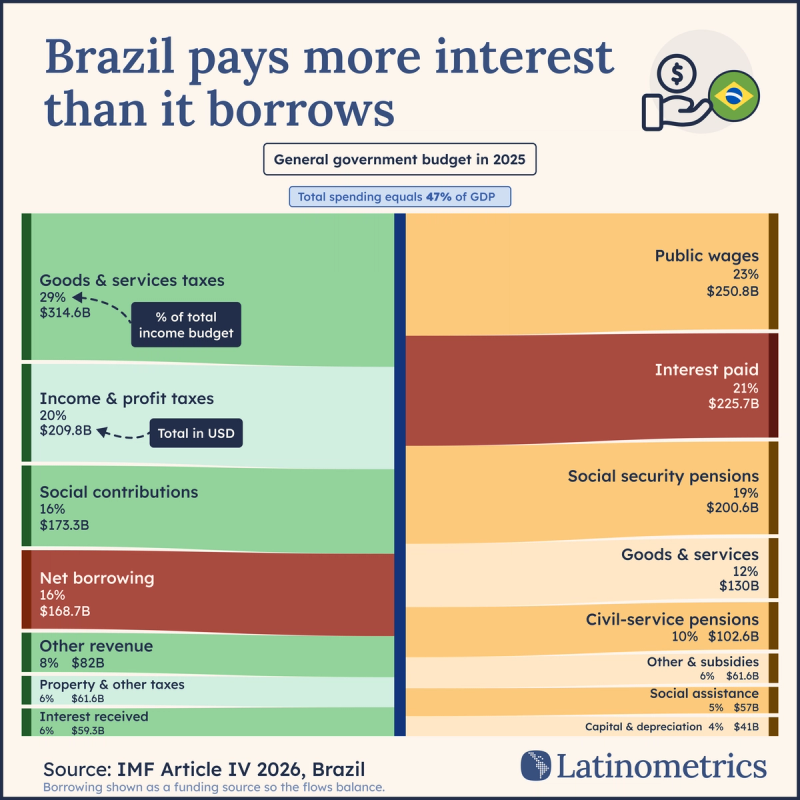
Brazil's government spends most of its budget on public wages, interest on its debt and pensions, which together took 73% of the $1.07T it spent in 2025.

Bem-vindos ao Brazil 2026 Elections Series! 🇧🇷
As the Brazilian general elections approach in October, we're running a weekly chart to unpack the key policy issues shaping this year’s electoral race. This nonpartisan series will examine the data beyond the narratives. Our hope is to give both Brazilian voters and foreign observers a clear picture of the stakes and opportunities at hand.
Brazil holds general elections every four years to elect both national and state executive and legislative officers. The presidential election functions through a two-round majoritarian system. That simply means a candidate must receive more than 50% of valid votes to win the presidency; if no candidate reaches that threshold in a first round, a second round is held with the two most popular candidates. This year, the first round is scheduled for October 4th, and the second round for October 25th.
Today we will look at national debt, which made Brazilian headlines in late August as new data sounded some alarm bells. According to the country’s Central Bank, the General Government Gross Debt (GGGD) hit a five-year high in July 2026, reaching 82.5% of GDP, or roughly $2.12T. So how does a country end up paying more in interest than it borrows in a year, and what do the people running for president plan to do about it?
The National Debt
In plain English, the GGGD is the Central Bank’s term for everything Brazil’s federal, state, and municipal governments owe to creditors, added together. To compare debt levels across countries, economists often present the national debt as a percentage of gross domestic product. Brazil’s debt peaked at 87.7% of GDP in October 2020, in the thick of the Covid-19 pandemic, slid to a low of 71.4% in January 2023, and has been climbing back up ever since.
Over the last few years, Brazil has, in fact, become one of the most indebted countries in Latin America, surpassing even neighboring Argentina—which still owes about $57B to the International Monetary Fund (IMF). However, to put this into perspective, both Brazil and Argentina stand below the debt levels of other major economies, including France, the United Kingdom, and the United States.
Debt usually builds up over time, when a country runs consistent budget deficits, meaning when government spending repeatedly exceeds government revenue. After years of running on deficits across governments of varying ideological stripes (most of the budget is locked into pensions, wages, and other mandatory spending, whoever is in office), Brazil has had to consistently borrow while facing high interest rates, which makes servicing that debt more expensive. As a result, the Central Bank is now caught between a rock and a hard place: while lowering interest rates may boost investment and reduce Brazil’s borrowing burden, it may also add inflationary pressure (that old economics song and dance).
In 2025, Brazil’s government spent roughly a fifth of its trillion-dollar budget on interest payments, as this chart using the IMF’s latest Article IV report shows. The latest 2026 data from the Central Bank tells the same story. In the 12 months through June, the government’s total shortfall came to nearly 10% of GDP, and interest costs alone accounted for 8.8 of those points. Strip out interest and the gap shrinks to 1.2%. Put simply, Brazil is mostly borrowing to pay for what it already borrowed.
That interest burden has real costs for Brazilians: it's the one large line in the budget that no minister negotiates and no Congress votes on, since its size is set by debt already issued and by the rate the Central Bank holds. That said, neither austerity measures nor higher taxes are very popular solutions to debt problems. So, candidates, what are your suggestions?
Candidates’ Proposals
Key: (first-round polling per Datafolha, mini bio)
Luiz Inácio Lula da Silva (PT) (39%; shined shoes at 12, ran a lathe at 14; sitting president, now going for a fourth term): wants to keep the current fiscal framework (the 2023 rule that caps how fast spending can grow), with spending limits and revenue recovery. Instead of proposing a new fiscal regime, he'd keep chasing a balanced budget by cutting tax breaks and benefits that don't pay off, taxing high incomes more, and closing loopholes. At the same time, he plans to hold or lower taxes for lower income taxpayers and protect social spending, including the constitutional floors for health and education.
Flávio Bolsonaro (PL) (35%; chose Vasco over the Botafogo of his father, former president Jair Bolsonaro; Rio senator since 2019): wants to rework social programs to help recipients move into jobs, cut at least 10 ministries, and cap subsidized credit paid for by the Treasury. He also wants to rewrite the current tax reform to lower taxes on production and consumption, trim exemptions, and carve out an exception for exports and investment. And he plans to go after fraud in the pension system with a new anti-fraud package, while committing to primary surpluses and a spending rule for all three branches of government.
Augusto Cury (Avante) (6%; small-town doctor from Colina, São Paulo, who wrote between patients; 35M books later, he's running): wants a gradual and sustainable reduction of public debt by growing the economy, keeping spending responsible, balancing the public books, and modernizing the State. He commits to a near-zero deficit while preserving strategic investments. He'd also study reducing the number of ministries, simplify both the government's structure and the tax code, and overhaul public-sector careers so the administration runs better.
Ronaldo Caiado (PSD) (4%; spine surgeon trained in Paris, cattle rancher in Goiás; governed the state until March): wants to start with a full audit of mandatory public spending, the bills the government has no choice but to pay, then build a multi-year plan to get back to primary surpluses and bring interest costs down, without passing the bill to the poorest or permanently raising the tax burden. He wants more transparency in fiscal policy and checks that slow the automatic growth in spending. He'd also cap excessive public salaries, run social benefits better, and line fiscal policy up more closely with monetary policy, while leaving the Central Bank's autonomy intact.
Renan Santos (Missão) (3%; grew up in São Paulo's Mooca, fronts a rock band on guitar and harmonica; leads Missão): wants to pass a constitutional amendment that would save a projected R$1.1T by 2031, according to the proposal's own estimate. The amendment would unhook pensions and the Continuous Cash Benefit (a monthly payment of one minimum wage to low-income elderly people and people with disabilities) from the minimum wage (tying them to inflation instead), remove the constitutional health and education spending floors, rework the wage bonus, and cap tax exemptions. His fiscal plan also calls for cutting privileges for senior public officials.
Five plans, one inheritance. Whoever wins starts day one with the same interest bill, and every promise above has to fit in what's left after paying it.


