
Is corruption in Brazil getting worse?
Corruption in Brazil looks worse on paper, from Lava Jato to Banco Master, yet watchdogs found more graft in 2025 than in the prior 22 years combined.

Bem-vindos to the last edition of the Brazil 2026 Elections Series! 🇧🇷
If you didn’t get a chance to watch last Sunday’s presidential debate between Flávio Bolsonaro and Lula da Silva, just know that we were spot on about at least one main issue: public safety opened the night.
But the longest, most heated exchanges went to another—corruption.
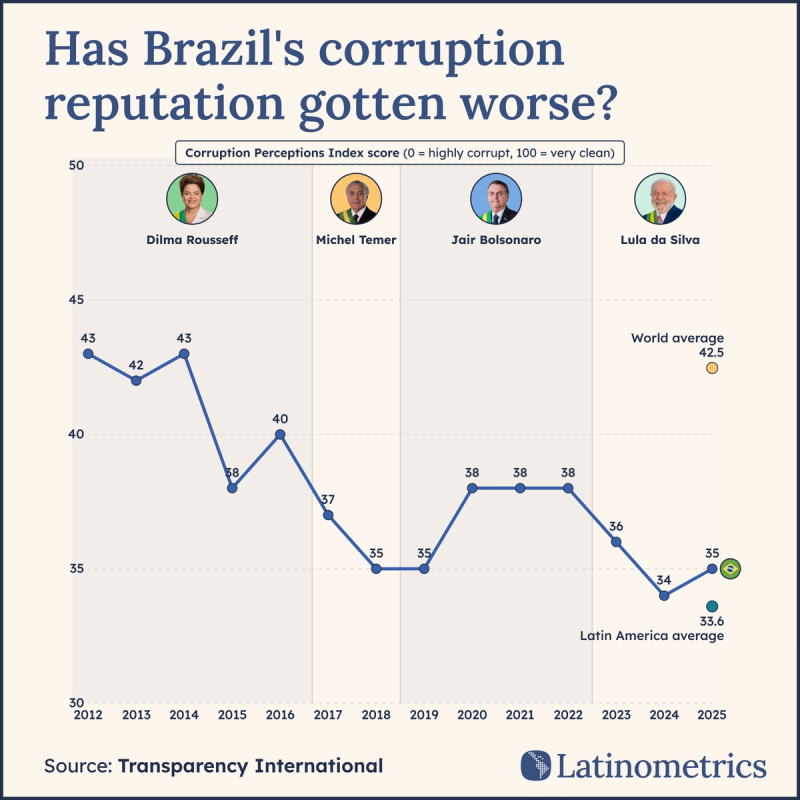
Brazil’s corruption problem has apparently gotten worse, at least according to Transparency International’s Corruption Perceptions Index (CPI), which measures the extent to which a country’s public sector is perceived as corrupt by experts and businesspeople.
In a scale where 0 means “highly corrupt” and 100 “very clean,” Brazil has dropped from 43 in 2012 to a low of 34 in 2024, with just a 1-point increase in 2025. That amounted to a fall from being the 69th least corrupt nation to the 107th. While perception has its limitations as a measure, such a downturn carries real consequences for public trust in government (also not doing great these days) and voting outcomes.
Corruption is ultimately the core of any government. Before we can ask any question about policy, we need to trust the government that is enacting it. So in this final edition, we ask: is Brazil getting more corrupt, or just better at catching it?
Grasping the Decline
In 2014, Operation Car Wash, or Lava Jato, uncovered evidence that contractors like Odebrecht had been bribing executives at state-owned companies, above all oil giant Petrobras, for years. In exchange, they got inflated contracts and used part of the proceeds to fund parties, campaigns and politicians across the spectrum. Odebrecht alone admitted to paying $788M in bribes across 12 countries, the largest foreign-bribery case ever, and the fallout reached presidents in Peru.
Although a number of parties were involved in the scandal, Lava Jato branded Lula’s Workers’ Party (PT) as the bastion of corruption. The investigation gave momentum in Brasília to a conservative movement that had struggled for over a decade to beat the left. By 2018, Lula’s protege Dilma Rousseff had been impeached over budget rules, and he himself was sitting in prison following a Lava Jato-connected corruption conviction.
Enter: Jair Bolsonaro, father of current presidential frontrunner Flávio Bolsonaro. The elder Bolsonaro won a polarizing victory in 2018 over the PT; once in office, he appointed the judge who had sentenced Lula to prison as his Minister of Justice, raising concerns of impartiality. In the years following, Lava Jato slowly wound down, with Lula released in 2019 and his convictions annulled in 2021.
Five years later, today, Brazil is once again caught in another massive corruption storm. This time it runs through Banco Master, a lesser-known bank whose owner, Daniel Vorcaro, courted politicians across the spectrum. Investigators are probing whether those friendships kept regulators off the bank’s back. Its 2025 collapse was Brazil’s biggest bank failure, leaving the banks’ deposit-guarantee fund owing savers $7.3B.
Flávio Bolsonaro himself is under federal investigation after leaked messages showed him negotiating $24M from Vorcaro for Dark Horse, a film about Jair Bolsonaro; he admits asking, and no charges have been filed. The nation’s highest court has also spiraled into a major crisis of credibility over Justice Alexandre de Moraes: Master hired his wife’s law firm for $23.9M over three years, and police say a user named “Ministro Alexandre de Moraes” edited the contract 53 minutes before Vorcaro got it. Moraes, a center-right Temer appointee who oversaw Jair Bolsonaro’s 2025 conviction, says the contract is legal; the court decides whether to investigate him after the runoff.
Though Lula is not personally implicated, his campaign has not gone unscathed. On top of PT’s persistent reputation for corruption, Lula faces scrutiny for an off-the-record meeting with Vorcaro in December 2024, arranged by ex-finance minister Guido Mantega, whom Master reportedly paid $185K a month. His son Fábio Luís faces a separate probe over a pension-fraud scheme, on indirect evidence: about $290K that a firm tied to its alleged lobbyist sent to a friend’s company, and one message naming “the guy’s son.” Police found no direct payments, and he denies wrongdoing.
More corruption, or better detection?
If Brazil's institutions keep catching powerful people, is Brazil getting better at fighting corruption? That depends on the detection rate. More cases found can mean more corruption, better detection, or both.
Joint operations by the CGU, Brazil's federal comptroller, and the Federal Police hit a record 96 in 2020, driven by Covid spending probes, fell to 37 in 2023, then more than doubled to 76 in 2025.
That year they uncovered $2.4B in losses, more than the previous 22 years combined, led by a pension fraud that skimmed retirees' benefits under Bolsonaro and Lula alike.
That's why Lula's anti-corruption minister, Vinícius Marques de Carvalho, calls indices like the CPI poor thermometers for graft: the better the CGU does its job, the worse Brazil ranks.
What the candidates propose
Whoever wins on Sunday will have the power to appoint the next agency heads responsible for tackling Brazil’s corruption issue.
Both Flávio and Lula are both nominally committed to fighting corruption, though they have slightly different approaches to handling the issue.
(Latest Datafolha runoff poll, Oct 13–15, a technical tie; first-round vote share, when abstention hit a 28-year high)
Flávio Bolsonaro (PL) (51%; 47.0%): wants to fight corruption mainly through public safety, law enforcement and deregulation, like Chile's Kast and Peru's Fujimori, on a model Bukele popularized. His platform ties anti-corruption efforts to combating organized crime and the financial networks of illicit trade, and he’d cut bureaucracy to limit the discretionary power and regulatory bottlenecks where bribery happens. He’d also name up to four Supreme Court justices, for a Senate with a right-leaning majority to confirm.
Luiz Inácio Lula da Silva (PT) (49%; 45.2%): wants to strengthen oversight, inter-agency coordination and transparency, bolstering federal investigative and auditing bodies. He supports strict enforcement of corporate compliance under the Clean Companies Act (Lei da Empresa Limpa), more spending data on the federal Transparency Portal, and continued asset tracking for public officials. He’d also name up to four justices for that Senate to confirm.
Source: Transparency International, Corruption Perceptions Index 2025


