
How Many LatAm Universities Are in the Top 1,000?
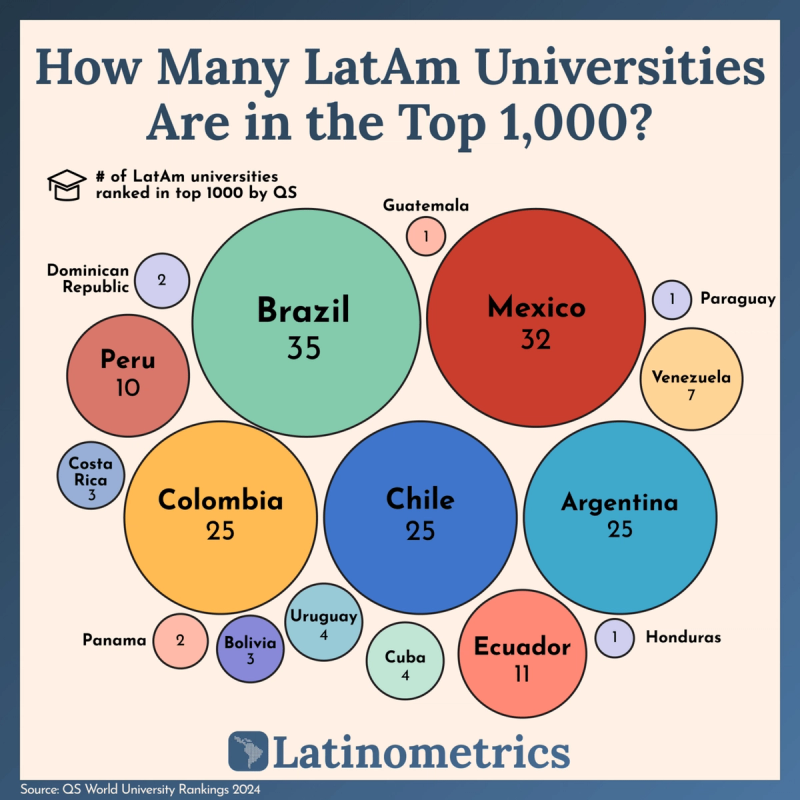
Brazil dominates, with Universidade de São Paulo leading the region's top-ranked universities.

Welcome to Latinometrics. We bring you Latin American insights and trends through concise, thought-provoking data visualizations.
Don’t forget to check out the comment of the week at the bottom!
Education 🏫
It’s been often said that education is a key which unlocks many doors. Whether you want to be a doctor, a lawyer, or whatever a “management consultant” is, chances are that a university education is the first step.
But too often the conversation gets reduced to the Ivy Leagues, or about which half of Oxbridge is better. As with so many other domains, Latin America’s top-tier colleges fly under the radar when they absolutely shouldn’t.
Let’s change that.
Today we’re looking at the QS World University Rankings for 2024, quite possibly the definite choice for evaluating universities. And what do you know, Latin America is well represented, with 191 of its universities making up just under a fifth of the top 1000 universities worldwide.
Unsurprisingly, Brazil and Mexico dominate here, with Latin America’s two largest countries each having over 30 universities in the upper echelon of academia. However, following them it’s a three-way tie for third place, as Argentina, Chile, and Colombia each have 25 universities among the world’s best.
From there, most of Latin America’s countries make an appearance, though Ecuador is interestingly better represented than its much larger Andean peers of Peru and Venezuela.
If so many universities in Latin America are worthy of praise, how do we know where to send our kids to become teachers, engineers, or “project managers” then? Let’s dig deeper.

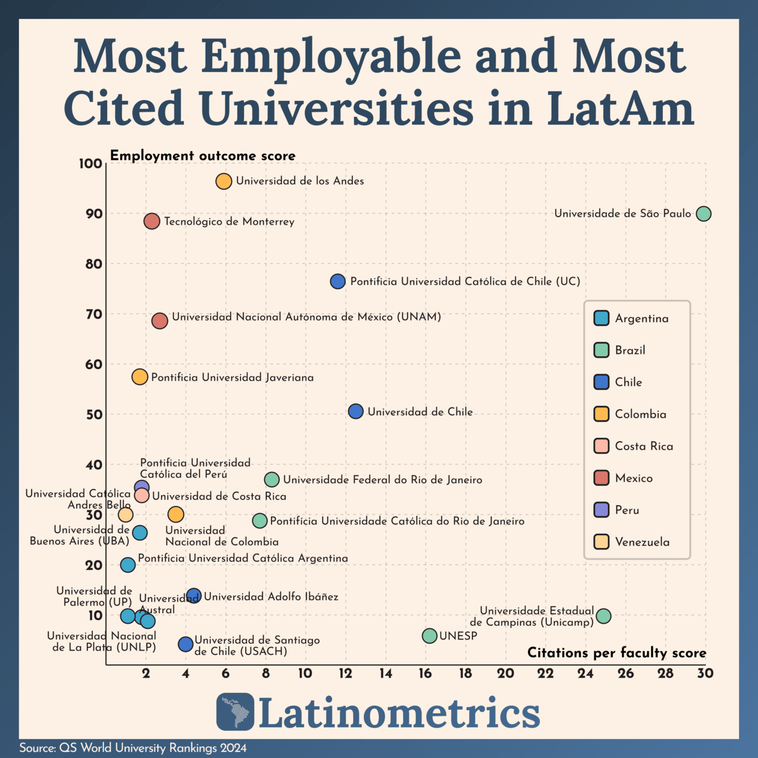
Brazil and Mexico not only top the region in quantity, but also quality. University of São Paulo (USP) and the Universidad Nacional Autónoma de México (UNAM) are Latin America’s best universities, with a level of academic excellence deserving of the sprawling metropolises that host them. While USP boasts thirteen Brazilian presidents among its distinguished alumni, UNAM is alone in the feat that every Mexican Nobel laureate has either studied or worked there.
These incredible universities are driving the region forward to greater successes—and they’re doing it as federally-funded public universities, showcasing what’s possible when a country invests in its future.
But don’t think that USP and UNAM are lonely at the top. Universidad de Buenos Aires and Universidad de los Andes lock in the Argentinean and Colombian presence, respectively. Meanwhile, Catholic universities founded by holy decree are themselves quite successful. One such university in Santiago is renowned the world over for the quality of its research, while our very own Senior Editor can attest to the fascinating research in international politics being carried out at the Pontifical Catholic University of Rio de Janeiro.
Some of these universities, like Uniandes or Mexico’s Tecnológico de Monterrey, are stellar based off the employment outcomes of their graduates. Others, like the three largest universities in the state of São Paulo, employ faculty who are widely-cited and respected within their respective fields.
Many of the federal universities on this list are tuition-free for students who pass their entrance exam, or offer subsidized lunches. They also have faced budget cuts in recent years but nonetheless produce some of their countries’ brightest minds.
No matter where you choose to obtain your Bachelor’s, PhD, or “Master of Business Administration,” selecting the right university is often the first step. Chances are, Latin America has got the right university for you—if you know where to look.
—
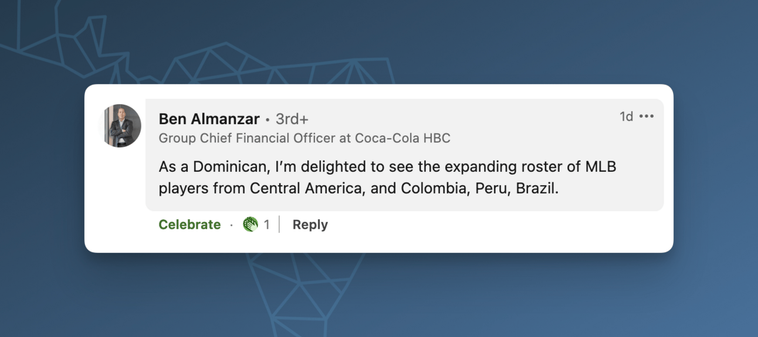
Ben Almanzar celebrates the rise of players from his Latin American peer countries. From our chart about MLB players on LinkedIn.
Join the discussion on social media, where we’ll be posting today’s charts throughout the week. Follow us on Twitter, LinkedIn, Instagram, or Facebook.
Latinometrics is a reader-supported publication. To receive new posts and support our work, consider becoming a free or paid subscriber.


