
More Brazilians bet online than own a single stock
Brazil's new investors went looking for risk, and betting apps turned out to be better at selling it.


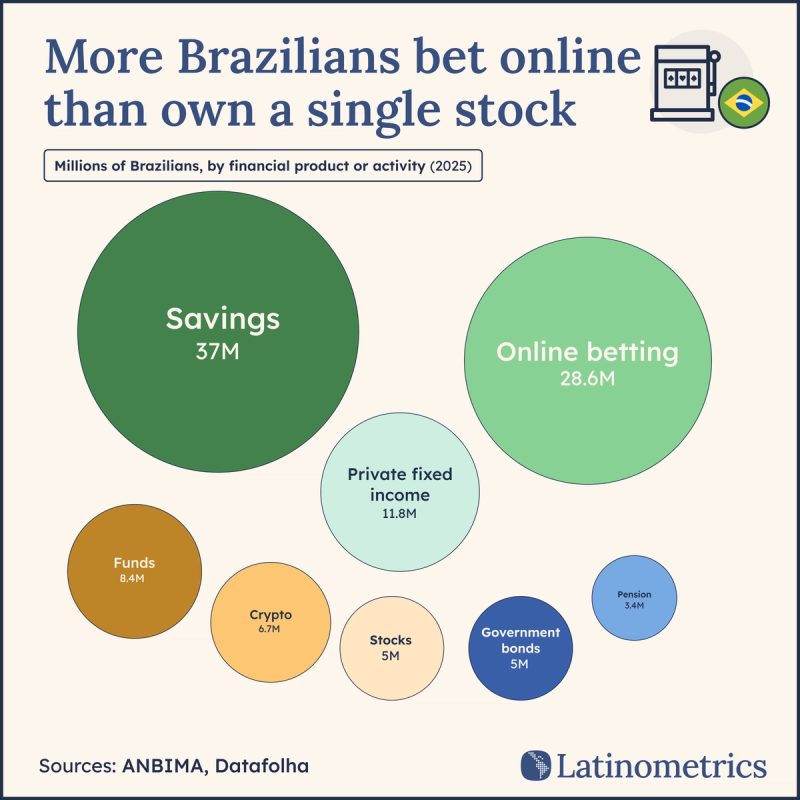
For a few pandemic years, ordinary Brazilians piled into the stock market. Then rates climbed, betting apps swept in, and that new appetite for risk went looking for somewhere else to go.
For a brief window, the answer was B3, Brazil's main stock exchange. In 2020, the country reached some of the lowest interest rates in its history, near 2%, and with safe yields that thin, millions of Brazilians tried stocks, funds, and trading apps for the first time. B3's retail base peaked around 2021.
But the window closed. As the Selic (Brazil's benchmark rate) climbed back into double digits, safe fixed income became hard to ignore again. Retail investors who had arrived in the cheap-money years faced a new tradeoff: volatile equities and futures on one side, high-yielding conservative products on the other.
Betting apps added another powerful pull. After Brazil moved to regulate online sports betting, a wave of apps (legal sportsbooks alongside grey-market casino games) swept the country. The most notorious, an online slot called Jogo do Tigrinho (Fortune Tiger), alone pulled in over $1.5B in revenue. A lot of traders moved from the regulated market to unregulated bets. For low-income users especially, betting offers a familiar proposition: small stake, instant result, the dream of a quick multiple. Picture a worker who just finished a shift, needs bus fare, and has three reais; increasingly, they will bet it hoping to triple their money.
This trend underscores the highly speculative nature of Brazilian retail trading, where B3 data already shows a massive appetite for high-stakes local derivatives. Yet even futures can't compete with the instant gratification of a betting app.
Brazilian investors are deeply connected, mobile-first, and inherently open to risk—they are just choosing platforms with zero friction.
The financial industry won't win on pure exhilaration, but it has a huge opportunity here. To win back this capital and audience, traditional institutions must evolve, bridging the gap between complex products and the effortless user experience that digital entertainment has already mastered.
This guest article was co-authored with our friend Alessandra Sily, a São Paulo-based International Market Development manager at CME Group. The article represents her views and ours, and not the views of CME Group.
| How Brazilians use their money (2025) | Share of population |
|---|---|
| Savings | 22% |
| Online betting | 17% |
| Investment funds | 5% |
| Crypto | 4% |
| Stocks | 3% |
| Government bonds | 3% |
Source: Anbima/Datafolha, Raio X do Investidor (9th ed.)


