
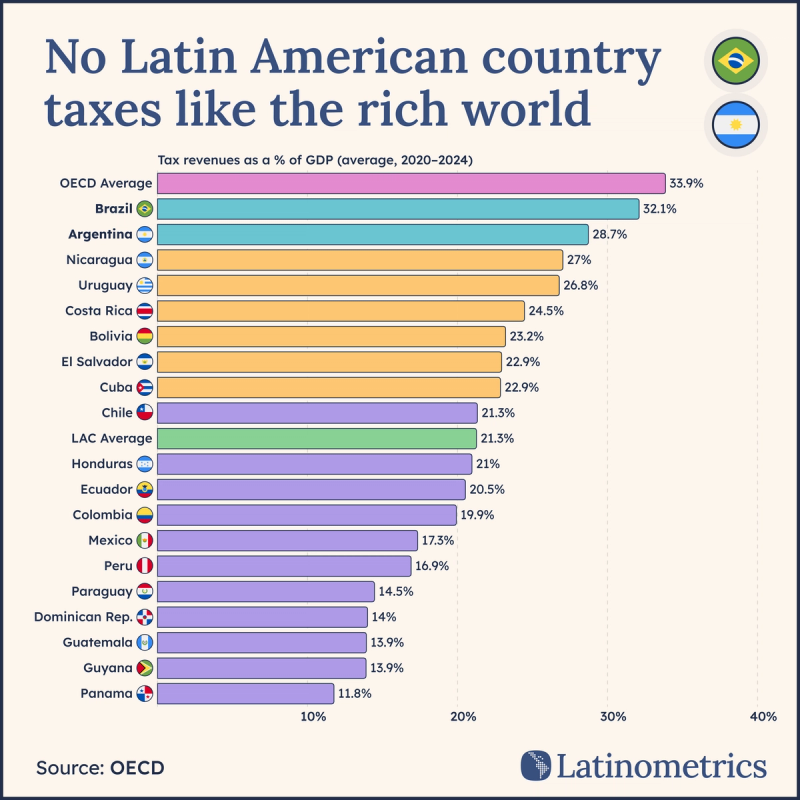
No Latin American country taxes like the rich world
From tax-haven Panama to debt-burdened Brazil, what you get back matters more than what you pay.

As you grew up, you started noticing that a portion of the money you make doesn't belong to you. Every day, when you interact with the economy in which you live, you contribute to a system, whether you want to or not.
Why put up with it? The simplest answer is that a country is not really a country if it doesn't have cash to operate things like roads, police, a legal framework that protects citizens and property, etc.
So yes, we all can agree that some form of tax is necessary; where it gets complicated is when we ask, "exactly how much is appropriate?"
A story of low taxes
Panama seems to think that the region's smallest share of economic activity going to the state is sufficient for its operations; that's almost one third of the OECD's average and about half of Latin America's. It came out to about $9.8B in 2024. Budgets like that have still bought Panamanians plenty over the years: Central America's first metro, which now moves around a quarter of a million riders a day; a sanitation program that finally stopped much of Panama City's sewage from flowing raw into the bay; and a monthly cash transfer for seniors who never got a pension.
How did they do it? To be fair, Panama is famous for being a tax haven. It bets on attracting global economic activity by taxing only what's earned inside its borders; foreign income goes untaxed, and special regimes like its multinational-headquarters law tax qualifying profits at just 5%. So, yes, it may tax little in comparison, but look at its GDP per capita and it ranks near the top of the region. Clearly, the strategy works to some extent.
No Latin American country taxes like the rich world
To be doubly fair, Panama has everything to position itself as a global attraction, anchored by its Canal, which moved 489M tons of cargo through more than 13,000 transits last fiscal year and connects the Atlantic to the Pacific at exactly the right position on the map. The Canal alone handed the treasury nearly $3B that year, money that arrives without taxing anyone at home. Most countries don't have an obvious advantage like that.
The tax of paying debt
So let's go to the other extreme in our region: Brazil. Its tax take is the region's highest, yet it still sits almost two percentage points below the OECD average, so no Latin American country meets the OECD average.
In 2024, it collected $572B in taxes, and if you're not a fan of being in debt, here's the painful part: $308B (or 54% of what the economy paid to the government) was spent on just repaying debts. Brazil borrows mostly from its own people. Domestic banks, pension funds, and investment funds hold about three quarters of the debt, and they don't lend cheap. The average cost of servicing it hit 11.8% in 2024 as the central bank pushed rates to 12.25%.
It would be silly to try to make a statement like "taxes are too high" because it depends on what you get in return, and that varies not only at the country or state level, but even at the level of the city and neighborhood in which you live.
Do you feel like you're not getting a fair deal? You have two options: demand lower taxes or demand better use of them.
| Country | 2000–2010 avg | 2020–2024 avg | Change |
|---|---|---|---|
| OECD average | 32.2% | 33.9% | +5.2% |
| Brazil | 30.5% | 32.1% | +5.1% |
| Argentina | 24.1% | 28.7% | +18.9% |
| Uruguay | 22.8% | 26.8% | +17.7% |
| Chile | 19.2% | 21.3% | +11.0% |
| LAC average | 18.2% | 21.3% | +16.5% |
| Colombia | 16.9% | 19.9% | +17.9% |
| Mexico | 11.6% | 17.3% | +49.5% |
| Peru | 16.3% | 16.9% | +3.7% |
| Guatemala | 12.1% | 13.9% | +15.0% |
| Panama | 15.7% | 11.8% | -24.9% |
Source: OECD Revenue Statistics in Latin America and the Caribbean 2026


