
Uruguay's Efforts to Reduce its Informal Economy are Working
Uruguay slashed informality by half in a decade, outperforming LatAm and nearing Europe's 17% rate.

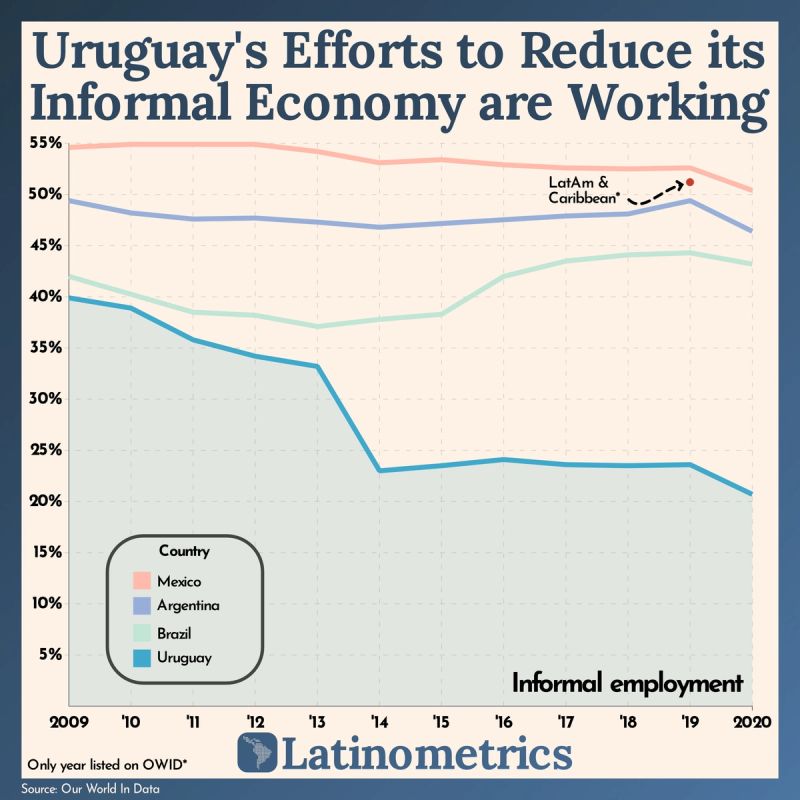
Uruguay has outperformed all other Latin American countries when it comes to eradicating informality, cutting it in half in the span of a decade.
Informal workers don't pay taxes and are not covered by social security, meaning that, although employed, they don't have access to social benefits like healthcare or pensions.
Having said this, it's no secret that Latin America has a vast informal economy, with more than half of its population working informally. In this context, Uruguay has become an anomaly in the region, with only a 20% informality rate. This puts them closer to Europe, which has a 17% rate.
The improvement did not happen overnight, though. It's a result of decades-long efforts. What can other countries learn from Uruguay?
After starting the century with an economic crisis, Uruguay saw sustained economic success, outperforming other countries in the region. Labor formality is a natural byproduct of economic success, meaning that the economic context laid the groundwork for their decline in informality.
However, this could not have been achieved without successful policies by Uruguay's government in various areas.
First, in 2005 the country set up policies to reactivate collective bargaining aka negotiations between employees and employers on working conditions. This has led to stronger unions in the country, which have worked towards workers' inclusion into social security. Second, the government has introduced several tax reforms, including tax incentives for employers to integrate their workers into social security. Lastly, the government has introduced other social programs, such as unemployment insurance and healthcare modifications.
Even as the pandemic brought about an increase in informal employment across Latin America, Uruguay's informality surprisingly decreased even further by an estimated 3% during this period. This phenomenon is still being investigated; however, some experts have pointed to a generalized failure of small businesses in the country, driving labor into larger companies operating in the economy's formal sector.


