
What is Mexico's biggest export?
Mexico's biggest export is now computers, which passed cars in 2025 as its factories began assembling the servers that power AI for the United States.


Just outside Guadalajara, in the municipality of El Salto, Foxconn is building what's set to be the largest AI-server assembly plant on the planet. It's investing close to $900M there to build machines around Nvidia's GB200 superchips, the kind of chips that power your chatbot every time you ask it how to keep your spouse happy.
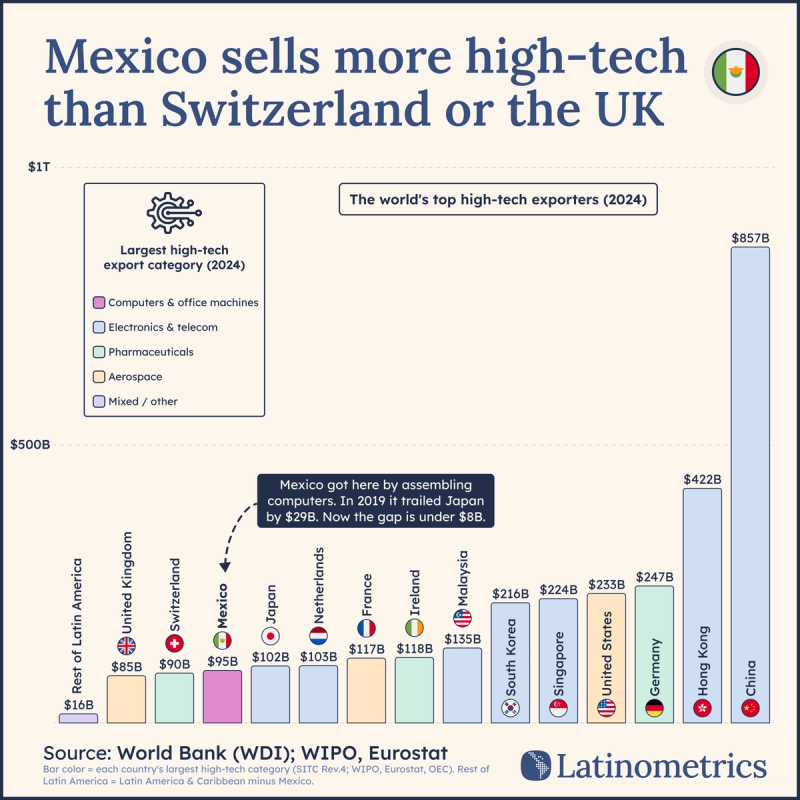
Machines like these became Mexico's biggest export last year, ahead of cars. Mexico dominates the region's high-tech exports, no contest. In 2024 it exported $94.5B in high-tech goods (the World Bank's label for research-heavy products like computers, pharmaceuticals, and aircraft), more than Switzerland or the United Kingdom, and ranked 12th among economies with World Bank data for that year. It will likely climb several spots when the new figures come out.
It gets interesting once you color each country by its biggest category. Mexico is alone in its color: none of the other big exporters has computers as its main category. In that lane, Mexico runs without competition. China, South Korea, and Singapore export electronics and semiconductors. Germany, Switzerland, and Ireland lead with pharmaceuticals. The United States and France lead with aerospace.
Mexico is a kitchen where the technology others design gets assembled. It receives the world's most expensive ingredients, chips included, puts them together with millimetric precision, and serves the dish.
The year computers passed cars
The shift toward computers sped up in 2025, when computer equipment exports grew close to 145% and pushed cars out of first place for the first time in Mexican history. Luis de la Calle, who helped design and negotiate NAFTA and later served as Mexico's undersecretary for international trade negotiations, reads this as leverage. "You cannot divorce Mexico in the leading-edge sector," he told Latinometrics. His advice to Mexico's negotiators is not to rush into concessions, since he thinks the US tariffs will most likely come off in the long run.
Part of the advantage comes down to tariffs. Product-level exemptions have partly shielded AI-related goods, and overall, imports from Mexico paid an average tariff of just 3.7% in 2025. That year Mexico sold the United States $157B in AI-related goods, almost double the 2023 figure, which made it the second-largest supplier, right on Taiwan's heels. So far in 2026, it supplies 40% of the servers the United States imports.
Mexico isn't settling for the kitchen
In Tonalá, ISE Labs bought land for a plant that will package and test semiconductors, the last step before a chip ships. Micron announced an engineering center in Guadalajara, its first in Latin America. And the Mexican government launched Kutsari, a national chip-design center with sites in Puebla, Jalisco, and Sonora. They're small steps next to Asia's scale, but they point toward the piece of the chain where the margin stays, and where the future economy seems to be heading.
And the small bar at the far left, the rest of Latin America, has its own specialists. Costa Rica is today the world's largest exporter of medical devices per capita and the tenth largest in absolute volume, with almost half of its goods exports concentrated in the sector.
In the end, the chart's colors record decisions sustained over decades: lithography in the Netherlands, pharmaceuticals in Ireland, catheters in Costa Rica, assembly in Mexico. The next entry on that list is being set up right now in Tonalá, Guadalajara, Puebla, and Sonora. Those are doors you can still knock on.
Source: World Bank (WDI); largest category from WIPO and Eurostat. Vietnam and Taiwan are not included (no 2024 data).


