
Colombia Stands out as a Modern and Digital Government
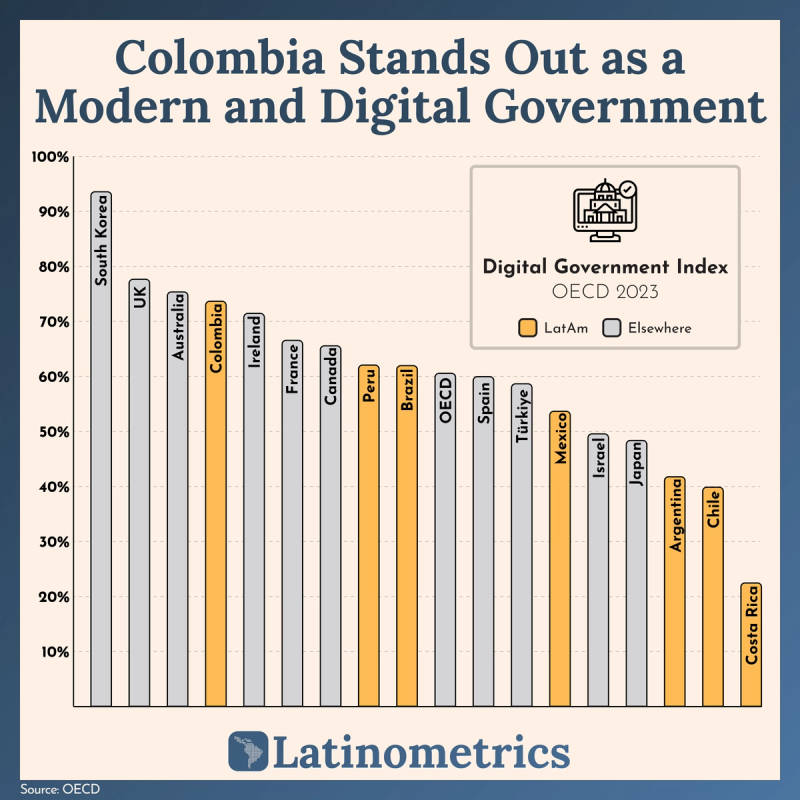
Colombia leads LatAm in digital government, outpacing Brazil and Peru with its 2018 policy and Cédula Digital.

Some countries are stuck in the past. Other countries are Colombia.
In the last few weeks, we’ve been looking for and speaking with some potential advertisers and partners. If you’re interested, fill out the quick form below:
This month marks four years since a worldwide pandemic left us all at home avoiding Zoom invitations while catching up on Netflix shows. It’s easy to forget now, but the pandemic was a (hopefully) once-in-a-lifetime moment for countries the world over, as overnight everything from leisure to everyday bureaucracy had to transition to the digital realm.
Immigration appointments were cancelled, borders were shut down, and best of luck if your driver’s license expired during those early months.
Some countries did quite well. Stories emerged from regions such as Europe and East Asia of serious virus tracking capabilities built directly into government-developed applications. This was particularly the case in countries which were hit hard and early by the virus, such as China, Italy, Spain, and South Korea. Other countries famously took less successful strategies.
With this in mind, today we’re taking a look at the state of digital government, as fresh memories of the global pandemic remind us all of the importance of modernized tech infrastructure equipped to handle global crises. For this, we’re consulting the results of the Digital Government Index as published late last year by our friends over at the Organisation for Economic Co-operation and Development (OECD).
As a reminder, the Paris-based OECD currently encompasses 38 mostly developed member countries, including 4 Latin American ones: Mexico, Chile, Colombia, and Costa Rica. Three other countries from the region – Argentina, Brazil, and Peru – are currently negotiating their own membership.
As the chart above clearly demonstrates, when it comes to the state of digital government Colombia is unmatched in the region. Latin America’s third-most populous country, an OECD member since 2020, outpaces even neighboring leaders like Brazil and Peru.
To explain this, indeed, one needs to look back to even before the pandemic. The Colombian government first launched its official Digital Government policy way back in 2018. Two years later, in November of 2020, the government under then-President Iván Duque began rolling out the so-called Cédula Digital, a joint physical and digital identification card which helped citizens access public services.
Focusing primarily on privacy, safety, and accessibility, this initiative is just one example of how Latin American countries are trying to take on today’s challenges in a competent, modern way. There’s lots of work to be done—but the future is digital, and governments know that.
After all, who knows what will be needed during the next pandemic.


