
Latin America taxes: how they compare to the OECD
Brazil collected more in taxes than any other Latin American country in 2024, yet still less than the OECD average, as income taxes bring in half as much.

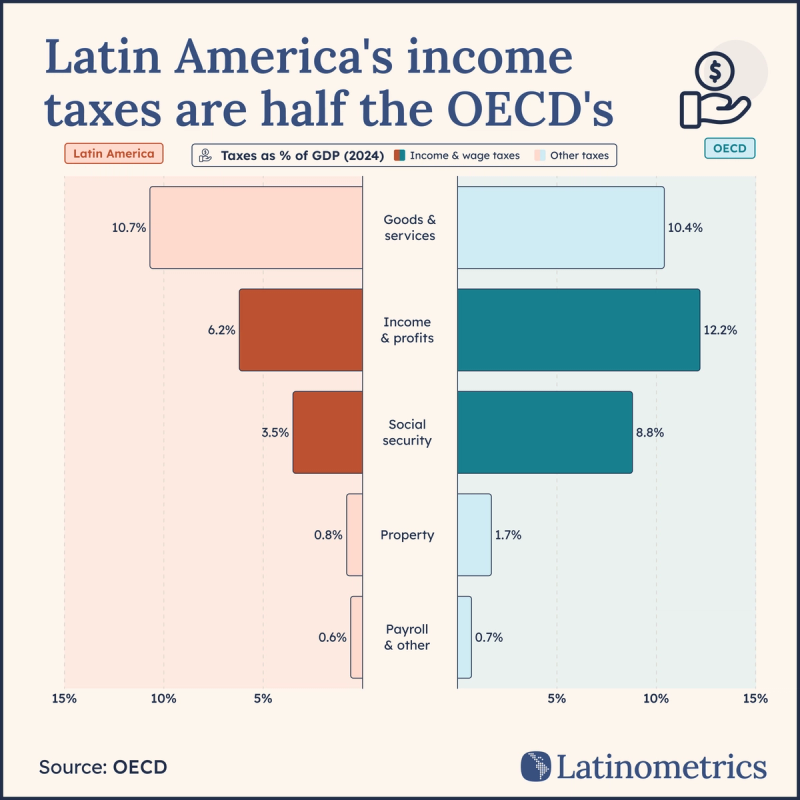
Taxes on goods and services hide inside the price tag, so it's easy to forget they're there. Yet Latin America collects about as much from them as the OECD does, as a share of GDP.
Consumption taxes account for almost half of tax revenue across countries in Latin America and the Caribbean, compared with less than a third in the OECD, a club of mostly rich countries. Only four Latin American countries are full members: Chile, Colombia, Costa Rica, and Mexico.
Collecting less than the OECD
The catch is a smaller pie. Every Latin American country collects less than the OECD's average tax take. Latin America's taxes add up to 21.7% of GDP, against 34.1% in the OECD, and most of the difference comes from income and profit taxes and social security contributions.
The starkest contrast is in personal income tax: just 2.2% of GDP in Latin America, compared with 8.2% in the OECD. Corporate income tax, meanwhile, raises the same 3.8% of GDP in both (2023 figures), making it a bigger slice of Latin America's tax revenue.
Social security depends heavily on how countries structure their welfare systems. In Chile, where pensions were largely privatized in the late 20th century, payments into private funds don't count as social security contributions, which bring in just 1.2% of GDP. At the other end, Costa Rica collects 8.9%, above the OECD's 8.8% (2023).
Informality and tax evasion in Latin America
Why does the region lean so hard on the cash register? Look at its stubbornly high levels of labor market informality. As of 2020, more than half of Latin America's workers were employed informally. In Bolivia, in particular, as much as 96% of the youth worked entirely in the informal economy in 2024.
Taxing paychecks harder would give informal workers one more reason to stay off the books. Governments can't see those wages, but they can track what workers buy from formal businesses. So consumption taxes become the more reliable source of revenue.
Even those on the books find ways around the taxman. In 2024, ECLAC estimated that $433B in revenue was lost to tax evasion and avoidance in 2023, equal to 6.7% of GDP. The bulk of these losses came from personal and corporate income taxes, while value-added tax evasion cost 2.1% of GDP.
Show citizens what their taxes already buy, and more of them will opt in before anyone has to ask for more.
Source: OECD et al., Revenue Statistics in Latin America and the Caribbean 2026, Table 3.1. Averages are unweighted.


